Titans of Luxury

Season One · Episode 01

The House of De Beers, Part 1

Jewelry · Est. 1888

How a single house turned a mineral into the language of devotion — and wrote the marketing doctrine that built an entire category.

1939 Build Grade: A− · 38 archival & academic citations · Full 2:41:20 transcript · Hosted by Nick Walker & Dolly Moorhead

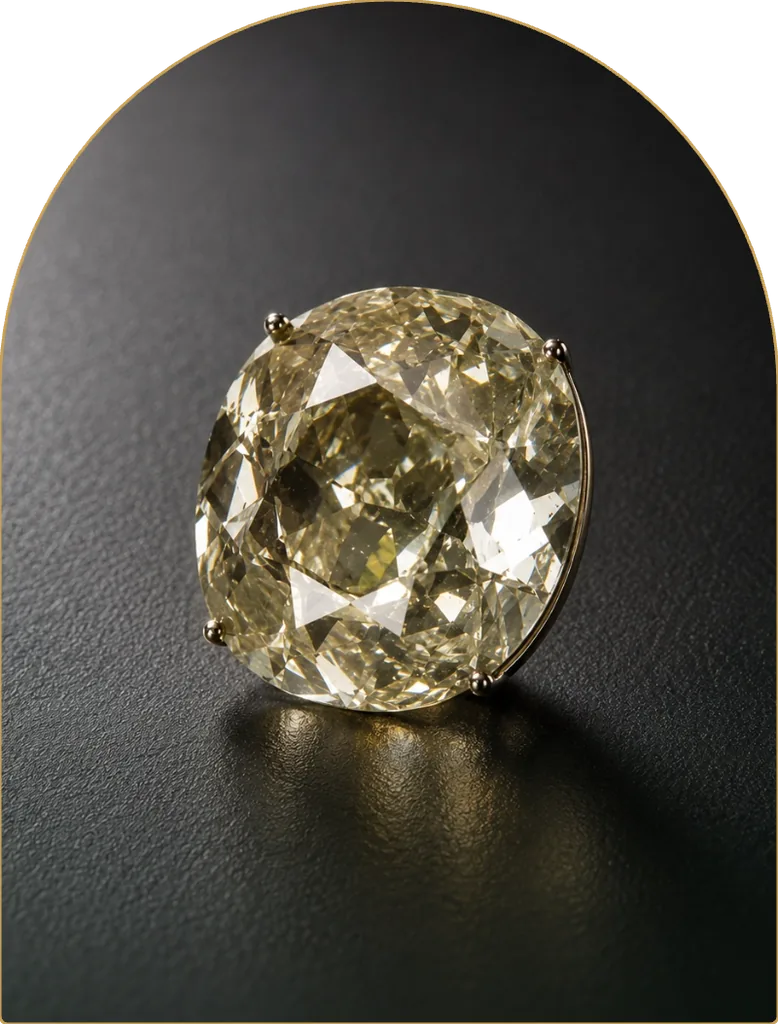
A cut De Beers diamond, photographed on a dark ground

What does Episode 01 argue about De Beers?

By 1939 De Beers had consolidated Kimberley (1888), wired the London Syndicate to take the whole of production, and put Ernest Oppenheimer on the spigot — scarcity as an operating decision, not a geological fact. We grade that build A− on the 5-Ms scorecard; Magnet is still only C because the engagement-ring campaign has not yet colonized American desire.

Nothing about a diamond is scarce. Part I traces how that fact was turned into a monopoly — alluvial India and Brazil, the Eureka stone, Kimberley, Rhodes buying the hole, Barnato at the Kimberley Club, and Oppenheimer taking the spigot. It closes on the Scorecard, graded at 1939, with De Beers sitting on forty million unsold carats. Part 2 follows the monopoly into the aftermath.

How De Beers scored in 1939

Build composite A− — editorial override of five letters graded to 1939.

01 · The Myth · Grade A− (NW A / DM B+)

What is the story, how well is it engineered — and how much of it is true?

At 1939 De Beers is still a mining and distribution house, not a consumer brand. Dolly marks B+ for maintaining scarcity without a customer-facing story; Nick files A — they still make people believe diamonds are rare, and he floats A+. The editorial conclusion is A−.

Where they split — Nick grades the scarcity myth as still intact; Dolly withholds the top marks because the house is not yet actively perpetuating a consumer story.

02 · The Men · Grade A− (NW A− / DM A−)

Who built it, who controlled it, who controls it now — and did they have the will to defend it?

Rhodes, Barnato, and Oppenheimer — the architects of amalgamation, the Kimberley Club deal, and the spigot. Dolly separates the businessman from the man on Rhodes and still lands A− for the period; Nick agrees on the composite for the first thirty or forty years.

03 · The Machine · Grade A+ (NW A+ / DM A+)

Does the operating system manufacture and protect scarcity — or leak it?

Compounds as inventory control, the London Syndicate’s exclusive offtake, output cut by a third once the monopoly is in hand — scarcity as an operating decision. Both hosts call it A+.

04 · The Money · Grade A+ (NW — / DM —)

Does capital serve desirability — or strip-mine it?

Rothschild money for the Kimberley Central wedge, JP Morgan behind Anglo American, a syndicate obliged to take the entirety of production. Both hosts call the financial engineering brilliant. The editorial conclusion is A+.

05 · The Magnet · Grade C (NW C / DM C)

What human need does the brand colonize — and do customers petition to spend?

Before the engagement-ring campaign, American demand is status without yearning — recognition, not petition. Nick opens at B+; Dolly holds at C; he is convinced. The grade of record is C.

What this episode is built on

Every figure quoted on the show is traceable. Archives consulted: 4.

Reporting

  1. Epstein, Edward Jay. “Have You Ever Tried to Sell a Diamond?” The Atlantic Monthly, February 1982. — Have You Ever Tried to Sell a Diamond?
  2. Green, Timothy S. “Buckets of Diamonds: The Precious Pebbles of Kimberley.” The British Empire 3, no. 29 (1972): 785–812.
  3. Newbury, Colin. “Technology, Capital, and Consolidation: The Performance of De Beers Mining Company Limited, 1880–1889.” The Business History Review 61, no. 1 (Spring 1987): 1–42.
  4. Nelson, Gill. “Occupational Respiratory Diseases in the South African Mining Industry.” Global Health Action 6 (2013): 1–10.
  5. McAdams, David, and Cate Reavis. “DeBeers’s Diamond Dilemma.” MIT Sloan School of Management, Case no. 07-045, January 7, 2008. — DeBeers’s Diamond Dilemma
  6. “Diamond VII: The Oppenheimers.” The New Yorker, September 29, 1956. — Diamond VII: The Oppenheimers
  7. “80% of World’s Diamonds Are Bought by Americans.” New York Times, November 13, 1928. — 80% of World’s Diamonds Are Bought by Americans
  8. “De Beers Consolidated Mines Limited / De Beers Centenary AG.” Encyclopedia.com. Accessed May 2026. — De Beers Consolidated Mines Limited / De Beers Centenary AG
  9. Cartwright, Mark. “How Diamonds Transformed Southern Africa: Kimberley’s Blood, Sweat & Segregation.” World History Encyclopedia, May 12, 2026. — How Diamonds Transformed Southern Africa: Kimberley’s Blood, Sweat & Segregation
  10. “Cecil Rhodes.” EBSCO Research Starters. — Cecil Rhodes
  11. Laniado, Ehud Arye. “Diamond Portraits: Monty Charles.” LinkedIn, n.d. — Diamond Portraits: Monty Charles
  12. Weir, Fred. “Russia Reveals It Is Sitting On ‘Trillions Of Carats’ Of Diamonds.” Business Insider, September 17, 2012. — Russia Reveals It Is Sitting On ‘Trillions Of Carats’ Of Diamonds

Books

  1. Kanfer, Stefan. The Last Empire: De Beers, Diamonds, and the World. New York: Farrar, Straus and Giroux, 1993.
  2. Epstein, Edward Jay. The Rise and Fall of Diamonds: The Shattering of a Brilliant Illusion. New York: Simon and Schuster, 1982.
  3. Cleveland, Todd. Stones of Contention: A History of Africa’s Diamonds. Africa in World History. Athens, OH: Ohio University Press, 2014.
  4. Cunningham, DeeDee. The Diamond Compendium. London: NAG Press, 2011.
  5. Grynberg, Roman, and Letsema Mbayi, eds. The Global Diamond Industry: Economics and Development. Vol. 1. New York: Palgrave Macmillan, 2015.
  6. Hofmeester, Karin. “Economic Institutions and Shifting Labour Relations in the Indian, Brazilian, and South African Diamond Mines.” In Colonialism, Institutional Change, and Shifts in Global Labour Relations, edited by Karin Hofmeester and Pim de Zwart, 67–107. Amsterdam: Amsterdam University Press, 2018.
  7. Cohen, Louis. Reminiscences of Johannesburg and London. London: Robert Holden & Co. Ltd., 1924.
  8. Cohen, Louis. Reminiscences of Kimberley. Kimberley Series, no. 7. Reprint. Kimberley: Historical Society of Kimberley and the Northern Cape, 1990.
  9. Raymond, Harry. B. I. Barnato: A Memoir. New York: E. P. Dutton and Company, 1898.
  10. Williams, Basil. Cecil Rhodes. New York: Henry Holt & Company, 1921. — Cecil Rhodes
  11. Williams, Gardner F. The Diamond Mines of South Africa. Vol. 2. New York: Macmillan Company, 1902. — The Diamond Mines of South Africa
  12. Flint, John E. Cecil Rhodes. Boston: Little, Brown, 1974. — Cecil Rhodes
  13. Bergstein, Rachelle. Brilliance and Fire: A Biography of Diamonds. New York: Harper, 2016.

Archives

  1. “Oppenheimer, Sir Ernest.” South African History Online. Last modified February 17, 2011. — Oppenheimer, Sir Ernest
  2. “The Big Hole.” Kimberley. — The Big Hole
  3. Michigan State University. “Cecil John Rhodes.” Overcoming Apartheid. — Cecil John Rhodes
  4. Nagin, Thomas, host. “Brazil — The Estrada Real.” Mineral Explorers, season 1, 2015. Directed by Jonathan Bryant Crawford.

Industry data

  1. Bergenstock, Donna J., Mary E. Deily, and Larry W. Taylor. “A Cartel’s Response to Cheating: An Empirical Investigation of the De Beers Diamond Empire.” Southern Economic Journal 73, no. 1 (July 2006): 173–189.
  2. King, Hobart M. “World’s Largest Diamond Deposit: Popigai Crater, Russia.” Geology.com. — World’s Largest Diamond Deposit: Popigai Crater, Russia
  3. “Siberia, Diamonds, and the Russian Diamond Industry.” Facts and Details. — Siberia, Diamonds, and the Russian Diamond Industry

Corrections & clarifications

Corrections are published here, dated, and never quietly edited into the audio. The published transcript already carries the corrected figures; the tape does not. Below them, the clarifications — contested claims, lore, and one item that has moved since we recorded.

Corrections

Rhodes became Prime Minister of the Cape Colony in 1890, not 1895.

The audio says he becomes prime minister in 1895. Rhodes took office in July 1890 and resigned in January 1896 in the aftermath of the Jameson Raid. 1895 is the year before the fall, not the year of the appointment.

Now reads: He becomes Prime Minister of the Cape Colony in 1890.

The Kimberley Central stake was built in 1887, not 1881.

The audio places the £1.1 million figure in 1881. The French company parcel, the £1.4 million purchase and the 20% stake all belong to 1887. 1881 predates the whole sequence.

Now reads: £1.1 million in 1887 would be something like £200 million today.

The VOC was founded in 1602 — the 17th century, not the 16th.

Stated correctly earlier in the episode (1602), then referred back to as “way back in the 16th century.” The Dutch East India Company was a 17th-century corporation.

Now reads: What the VOC did back in the 17th century.

Oppenheimer was knighted by a king, not a queen.

The scorecard segment says he “still gets knighted by the Queen of England.” Ernest Oppenheimer was knighted in 1921. The reigning monarch was George V. The episode gets this right earlier — “knighted by the King in 1921” — and then contradicts itself.

Now reads: He still gets knighted by the King.

The Excelsior diamond does not hold a current world record.

The audio says the Excelsior “holds one of the world records actually, still to this day.” Found at Jagersfontein in 1893 at 995.2 carats, it was the largest known rough diamond in the world until the Cullinan surpassed it in 1905 — that is the accurate claim. It has since been passed by several stones, including the Cullinan (3,106 ct), the Sewelô (1,758 ct) and the Lesedi La Rona (1,109 ct). The Cullinan’s own claim in the episode — largest gem-quality rough ever found, still today — is correct.

Now reads: Was the largest known rough diamond in the world until the Cullinan surpassed it twelve years later.

The Cullinan was cut into nine major stones, not ninety-one.

The audio says “it’s 91 other large cuts.” The Cullinan yielded nine major numbered stones (Cullinan I, the 530.2-carat Great Star of Africa, is the one in the Sovereign’s Sceptre) plus roughly 96 smaller brilliants and some unpolished fragments. The “91” is almost certainly a mishearing of “nine.”

Now reads: Nine more major stones plus close to a hundred smaller ones.

The Brazil / India carat comparison was garbled mid-sentence.

The numbers are correct but the spoken sentence collapses. The intended point: roughly 10 million carats had been found in all of human history up to that point; Brazil exported over 1.6 million carats between 1732 and 1771 — so in forty years, something like 15% of every diamond ever found came out of one country.

Now reads: 1.6 million carats in forty years, when roughly 10 million carats was the total ever found in all of human history up to that point.

The De Beers cheque figure.

The audio gives £5,338,000, and the transcript currently carries that figure. The figure that appears in most secondary accounts, and on the framed cheque itself, is £5,338,650. Photographs of the cheque are usually credited to Gardner F. Williams, The Diamond Mines of South Africa (1902/1905).

Clarifications

The Cape Assembly quote is almost certainly apocryphal.

“Gentlemen, this is the rock upon which the future of South Africa will be built.” Flagged in the episode itself: the Cape Assembly sat roughly six months after the Star of South Africa had already been shipped to London for cutting, so the scene as usually told cannot have happened. We include it because it is in nearly every secondary source, and because how a line like that survives fact-checking for 150 years is part of the subject of this show.

The “bucketful of diamonds” story is lore.

Rhodes asking Barnato to fill a pail so he could run diamonds through his fingers. Also flagged on air. It is in the standard accounts and it is almost certainly embellished — by 1888 Rhodes had access to as many diamonds as he could want, which is the objection raised in the episode.

The origin of the name “Barnato” is a good story, not a documented one.

The “and Barney too!” account of the stage name is the traditional explanation and appears widely. We have not found a contemporaneous source for it. Treat as plausible, unverified.

The “three bathtubs” and “ten million carats” figures are estimates.

Both trace principally to Edward Jay Epstein’s The Rise and Fall of Diamonds, one of the main sources for the episode. They are useful orders of magnitude rather than measured quantities, and Epstein has his critics.

The 1932 sales figure ( 00,000) should be attributed.

It is the single most striking statistic in the episode and the one most likely to be challenged. It circulates via Epstein. The claim as aired: the entire world diamond market for 1932 was 00,000, against 6 million in 1927.

The Standard Oil comparison is approximate.

“Standard Oil at its peak might have had 90% of US supply, but only around 70% internationally.” Standard Oil’s ~90% share refers to US refining capacity around the early 1880s, and had fallen to roughly two-thirds by the 1911 breakup. The international figure we could not source precisely. The underlying point — that De Beers achieved a tighter global grip than Standard Oil ever did — holds; the specific percentages should be read as approximate.

Herbert Hoover’s role in Anglo American is often overstated.

William Lovell Honnold was Oppenheimer’s substantive American partner and the conduit to J.P. Morgan and Newmont. Hoover — then a prominent mining engineer — was connected to that circle, and the story is irresistible, but the episode’s framing gives him more weight than the record clearly supports.

Solly Joel appears twice, twenty years apart. Not an error.

He is named as the man on deck when Barnato went overboard in 1897, and again as the mining magnate who loses a $50 bet to a young Ernest Oppenheimer in Kimberley in the early 1900s. Same man, both times. Barnato’s nephew inherited a large part of the empire and remained a major figure in the industry for decades afterward. The sequence is chronological and consistent; it simply reads oddly because the episode tells the death first.

Rhodes and African voters in 1880 is a contested claim.

“He actively courted and reportedly paid over 250 African voters.” The Cape franchise was property-based and non-racial on paper, and Rhodes did court that vote in Barkly West. The payment figure should be read as reported, not as a documented total.

Gandhi’s £3 tax — more precisely.

The £3 annual tax applied to formerly indentured Indian labourers who remained in Natal rather than to Indian workers generally. It was repealed under the Indian Relief Act of 1914, following the 1913 campaign described in the episode. The episode’s “eventually repealed” is correct but vague.

The Cullinan and Premier Mine naming.

The mine is the Premier Mine (Transvaal), renamed the Cullinan Diamond Mine in 2003 after the town and the stone. Thomas Cullinan was the mine’s owner, and the diamond was named for him. The episode occasionally uses the two names interchangeably, which is fine in speech but worth knowing.

De Beers ownership today has moved since recording.

The episode says De Beers is “partially owned by the Botswana government.” That was and remains true — Botswana holds 15%, with Anglo American holding 85% — but the picture is actively changing. Anglo American announced its intention to divest De Beers in May 2024; in September 2025 Botswana and Angola were reported to be seeking a majority stake; and as of 2026 Anglo has reportedly selected a buyer while Botswana weighs its options, with the business valued at a fraction of its historic worth. Part 2 covers power today. This note is dated 10 September 2026; the position will move. Debswana, the 50/50 joint venture between De Beers and the government of Botswana, is a separate entity from the 15% stake in De Beers itself. Both are commonly described as “Botswana owns part of De Beers,” and conflating them is a standard error.

Full episode transcript

2:41:20 · 23 chapters. Expand any chapter to read the edited tape.

00:00Cold open — Nobody knows De Beers. Everybody knows diamonds.

NW Dolly, quick question. When I say "De Beers," what comes to mind?

DM Honestly, until a couple of years ago — nothing, really. But then I was chatting with one of my good friends, and he happened to mention that his grandfather had been CEO of De Beers back in the day. He was clearly expecting me to be impressed, and I basically just stared at him blankly. He stopped, looked at me, stunned, and said, "Dolly — they controlled 90% of the world's diamonds." And I genuinely had no idea.

NW Well, that's the funny thing. Cartier and Tiffany have done a much better job of becoming household names, but De Beers is the most successful market control operation ever built. They controlled everything in the diamond business — the mines, the sorting houses, the stockpiles, the distributors. They controlled the cultural meaning of diamonds themselves. So what about when I say "diamond"? What comes to mind then?

DM The first thing is an engagement ring, of course. Diamonds are a girl's best friend. We think of a diamond engagement ring as the one luxury every woman gets at some point in her life — a symbol of love, of devotion. I remember being a little girl looking at my mom's ring, hoping that one day I'd get one of my own.

NW Well, that's the entire story of De Beers. So without further ado, let's take a look at it. Welcome to episode one of Titans of Luxury. I'm Nick Walker.

DM And I'm Dolly Moorhead. We're the managing partners of Folclore Capital, a growth equity fund focused on luxury consumer brands.

NW And let's get a few housekeeping things out of the way first. The perspectives shared here are our own and shouldn't be taken as an official stance of Folclore Capital, its partners, or the team. We're here to talk about business history and the mechanics of luxury. Nothing here is intended as investment advice or a solicitation for the fund we manage. This is strictly for educational and entertainment purposes.

02:17Are diamonds actually rare?

NW So with that out of the way — are diamonds really as scarce and precious as we've all been led to believe, Dolly?

DM The great irony is: not at all. Diamonds are just made of carbon, which is the fourth most abundant element in the entire universe. Sapphires, rubies and emeralds are all orders of magnitude rarer in the natural world.

NW So the real question is: how do you take a commodity that the earth produces in essentially unlimited quantities and convince the entire world that it's eternal, scarce and priceless? And I don't just mean consumers. I'm talking about the wholesalers, the cutters, the governments, the miners, the traders. Everyone in the chain has to believe it and behave accordingly.

DM Well, that's the magic of marketing.

NW So wait — are they rare, or are they not rare?

02:59India and the three bathtubs

DM Today, they're not. But let's go back to why people think they are. For most of human history, up until the 18th century, diamonds were only found in India. In fact, that became one of the problems when they started being discovered elsewhere — the overwhelming consensus was that diamonds only came from India. They came from what were known as alluvial deposits in the riverbeds — essentially diamonds that had been pushed up toward the earth's surface and then washed downstream. If you sorted through enough mud, you might be lucky enough to find one. Which is not a very efficient way to find diamonds. It meant that only about three bathtubs' worth of diamonds had ever been found. For the entirety of human history, that's not very much at all. And that becomes the benchmark for just how much gets produced in the years that follow. So that's the stage: diamonds came only from India, until something was discovered in your home country.

NW Brazil. But before we get there — do you know who understood the whole thing about diamonds first? The ability to move value across the world precisely because they were rare and came from India. Which group figured that out earliest and quickest?

DM Yes — the only people who were allowed to do moneylending.

04:23The network that owned the cutting

NW The Jewish merchant networks of Europe and the Middle East really understood this. Because Jewish merchants were legally barred in most of the world at that time from land ownership and from the guild professions, the only things left open to them were long-distance trade, moneylending and valuation. Diamonds were the perfect fit. Over generations, these communities built deep, multi-generational expertise in cutting, grading, financing and moving diamonds across borders. By the 1500s you have established direct sea routes from Goa in India to Lisbon, and an incredibly sophisticated network to move the stones, polish them, cut them and sell them on. Then, after the Inquisition reached Portugal, those merchants fled to Amsterdam. And because diamonds are small and portable, and because the tools required to cut and polish them in the 1500s were so simple, the whole industry packed up and moved overnight. Amsterdam became the European diamond capital — really the world's diamond capital — effectively overnight.

DM Right. But look at where the leverage sits. It isn't the Indians getting rich from these diamonds. It's this Jewish merchant network. And that network is completely portable — it moves throughout history — but it still controls the one thing that actually produces and captures the value, which is the processing of the diamonds. And that's something we'll see not just in diamonds, but across the whole luxury industry. It's never the groups that produce the commodity. It's the ones who know how to process and refine it who capture the value.

NW Well — do you want a rough diamond on your ring?

DM It's not nearly as shiny. It makes sense when you put it that way. And in a sense you can also control supply — as they do later on — by controlling how much gets processed, by controlling that knowledge.

NW The other interesting thing is where the capital ends up. As you said, it's the merchant networks in Amsterdam. And those same networks are what go on to finance the Dutch East India Company — the VOC — founded in 1602 as the world's first joint stock company. What makes the VOC truly different isn't just the financing structure, it's the powers it was granted. This was a company that could mint its own currency, negotiate treaties, wage war and found colonies. So Amsterdam doesn't just become the diamond capital of the world — it becomes the centre of global trade, full stop.

07:00Brazil floods the market

NW Now, luckily for the Portuguese, they had just discovered a whole new country — Brazil — and they had gold miners out there exporting gold to Europe. It's gold miners working along the Jequitinhonha River in Minas Gerais — which literally translates to "general mines" — who start finding transparent crystals in the river gravel. At first they throw them away. But by the 1720s, a miner familiar with Indian diamonds recognises exactly what they are. Within about five to ten years, Brazil becomes the world's leading diamond producer, replacing India. Between 1732 and 1771, Brazil exports over 1.6 million carats to Europe. Global rough diamond prices collapse by 75% in just a couple of years.

DM And to put that in perspective — that's 1.6 million carats in forty years, when roughly 10 million carats was the total ever found in all of human history up to that point. So in forty years, something like 15% of every diamond ever found came out of Brazil. Versus tens of thousands of years for everything before it. That's a huge disruption.

NW So the Portuguese start panicking. You have this enormous supply influx, and something that was considered extremely rare is suddenly everywhere — which is what causes the price to collapse. One of the things they try is secretly shipping Brazilian stones back to India to pass them off as Indian diamonds and protect the price. They manufacture the provenance to create fake scarcity. This is still the 1730s and 1740s. As mines open and close and the market swings with these huge volumes of supply, the price of rough diamonds is wildly volatile. But the price of cut stones is quite stable — because everything has to pass through the bottleneck in Amsterdam, where the Jewish merchant traders are grading, cutting and polishing.

DM Right. And there's the rule. The highest leverage point in the chain is never production. It isn't the miners who get the money. It's the people turning the commodity into the luxury product.

NW This is a lesson we're going to see over and over again in this story. India had the rough and didn't capture much of the value. Then Brazil had the rough — a lot of it — and also lost the value. And then Amsterdam, which had the processing power because of the merchant network and its gateway into Europe, eventually loses that too, to Antwerp, when Belgium makes a deliberate industrial policy decision we'll get into later.

DM So what happens after this forty-year boom in Brazil?

NW Through the early 19th century the Brazilian alluvial deposits start running thin. The Indian riverbeds have been exhausted for generations — very few diamonds are being found there at all. By the mid-1800s there's a genuine belief spreading through the world that diamonds might be running out. The merchant networks are looking at shrinking inventory with no visible replenishment in sight.

DM The irony is that they'd just spent decades panicking about exploding supply, and now it's becoming a gradual extinction event.

10:571867 — the Eureka Diamond

NW That's right. Until 1867. That's when a farmer named Schalk van Niekerk is visiting his neighbours and spots the children playing a traditional game called mooi klip — something like knucklebones, or gonggi in South Korea, if you've seen Squid Game season two.

DM The game is five stones. And there's one stone called the mooi klip, which means "pretty stone."

NW Exactly. So Van Niekerk sees that one of the stones is catching the light in an unusual way. He asks where it came from, and the fifteen-year-old boy says he found it on a riverbed and brought it home for his sister. Van Niekerk offers to buy it, but the mother insists he take it as a gift. He suspects it might be a diamond — but diamonds had only ever been found in India and Brazil. So he runs every amateur test he knows: scratching it against glass, dipping it in water, holding it up to see if it glows in the dark. Eventually he gives up, still uncertain, and sells it for a few pounds to a travelling trader. The trader takes it to Hopetown and becomes a laughing stock. The merchants dismiss him outright — one of them bets him a dozen beers that it's worthless. He eventually gets to Colesberg, where the acting civil commissioner scratches it on a windowpane and thinks: you know what, this might actually be real. The stone makes it to an amateur mineralogist called Dr. Atherstone, who incidentally was already famous for being the first surgeon in South Africa to use anaesthesia.

DM That's really weird. Gemology and anaesthesia are pretty different, don't you think?

NW They are. But Atherstone confirms it: it's a diamond. And he rushes to tell his next-door neighbour, the Catholic priest Father James Rickards, who — out of sheer excitement — takes the stone and carves his initials into his windowpane, "JR." That engraving stays there for decades. A small, quiet inscription marking the moment something changed forever.

DM It actually does become a bit of a tourist destination — people go to see where the South African diamond rush started. But that's not for a while. For a while, nobody really noticed.

NW Well — almost nobody. The stone gets named the Eureka Diamond and is sent to London for official confirmation. And right around this time the British decide to send geological experts to South Africa to analyse the region. Their final verdict: there are no diamonds in this region. The geology is simply wrong, and everybody already knows this.

DM Just like everybody knew there were no diamonds in Brazil.

NW Exactly.

DM So in March 1869, a Griqua shepherd named Swartbooi finds a much larger stone — very shiny, almost the size of his fist — and coincidentally brings it to the same farmer, Van Niekerk. Seeing a stone like this for the second time, he doesn't hesitate. He buys it outright. Do you know what he paid the shepherd?

NW I don't. Surprise me.

DM Five hundred sheep, ten oxen and a horse.

NW What is that — the leftover animals he had in his yard?

DM Honestly, I'm not sure. But I think that's what was of interest to the shepherd. And the stone is 83¾ carats, which at that point made it one of the largest ever found. Van Niekerk brings it to a jeweller in Cape Town, who buys it on the spot for £11,500 — a little under $2 million in today's money. It's named the Star of South Africa and sent to Lilienfeld's in London to be cut and polished. The eventual buyer is the Earl of Dudley, who pays £30,000 — about $5 million today. And I want to highlight this: the original stone sold for less than half of what it fetched afterwards. That means the majority of the value is not in the rough. It's in the cutting, the polishing, the creation of the actual luxury good — not in the commodity itself.

NW That's one of the most interesting things about luxury goods: how much of the margin is captured downstream, relative to the raw materials going in. Diamonds make it very easy to visualise, because you have the rough stone, and then the polished, cut, finished product. It's very different from assembling a handbag — but it shows one of the core dynamics of the luxury industry compared to other industries very clearly.

DM That's really true.

NW So let's focus on Cape Town and South Africa. Two or three years earlier, this same man, Van Niekerk, couldn't sell a diamond for any price. He was a laughing stock. Now there's a second one. And the person who put it best — we saw this in a few of our sources — was the colonial secretary, who reportedly displayed the Star before the Cape Assembly and announced: "Gentlemen, this is the rock upon which the future of South Africa will be built."

DM Here's something really fun, Nick. One of the things we ran into in our research is that with these very old sources, there was no internet — you couldn't check whether timelines added up. This line is in the lore. It's in most of our main sources. But it could not have happened. Do you know why?

NW Why?

DM Because the meeting of the Cape Assembly was six months after the Star had already been shipped to Lilienfeld's for processing. So it's an example of the myth getting away from itself, because it's a great story. It just couldn't have happened.

NW This is one of our five Ms, right? The myth — where we try to get at what actually happened versus what everyone says happened.

DM Exactly.

16:37The rush

NW But the sentiment is real. And the signal is now impossible to ignore. Within a couple of years of the second diamond being found, over 50,000 people move to and camp in the Northern Cape. British settlers, Boer farmers, Australian prospectors, American Civil War veterans with nothing left to lose. All of them now desperately looking for diamonds.

DM Let me quickly clarify something for our listeners, because not everyone will know what a Boer is. We're not saying "boar," B-O-A-R, like the animal. It's Boer, B-O-E-R — the original Dutch settlers who arrived long before the British and established their own colonies. They're a bit like the Puritans in the US. They created their own culture, they were farmers, they were austere — sparse, a bit like the Amish. They weren't a luxurious people; they didn't buy into excess. But before the English arrived, they were the largest settler population in South Africa. Keep a pin in that, because they own the majority of the farmland.

NW So the Boers own a lot of the farmland, and they're reselling claims — little lots — to individuals arriving from everywhere. Some of these individual claims are only a few feet across, and people are digging straight down, looking for diamonds, trying to get rich quick. This marks the moment where everything turns upside down again. You went from scarcity after India, to plentiful supply in Brazil, to scarcity as those ran out, and now once again a huge amount of supply entering the industry.

18:52Kimberlite pipes

NW And where these discoveries are happening — the area that eventually becomes Kimberley — people realise these aren't alluvial finds. These aren't crystals washing downstream from some unknown source. These are something that comes to be called kimberlite pipes. Do you know what a kimberlite pipe is, Dolly?

DM I'm a diamond fanatic, so I do — but you're better at explaining it than I am. I get my geology muddled.

NW A kimberlite pipe is essentially the source of the diamonds themselves. In the alluvial scenario you don't really know where they come from; they're spread out everywhere with no identifiable source. The original source is these kimberlite pipes. This is how diamonds actually get made in nature. Picture a volcanic structure shaped roughly like a carrot, or an inverted cone, punching up through the earth's crust a hundred million years ago. Deep in the mantle — 150 kilometres down, about 93 miles beneath the surface — under enormous pressure and heat, carbon crystallises into diamond. The kimberlite eruption acts like an elevator, carrying those crystals violently upward. Most pipes eroded away over geological time, and their diamonds were scattered into rivers and coastlines. That's what alluvial mining is. But at Kimberley, the pipes are intact. You're not chasing diamonds downstream — you're standing directly on top of the source. The two Boer farmers sitting on top of one of these pipes are named Johannes and Diederik de Beer. That's where the De Beers name comes from. They sold their farm to prospectors for around £6,000 — life-changing money for them, roughly .25 million today. But relative to what that land went on to produce, it's probably one of the worst deals of all time. And of course, with all of this activity, the government moves in.

DM Funny how that happens when there's money.

NW Exactly. The British send colonial commissioners who arrive at New Rush in the early 1870s to exercise authority over the territory on behalf of the Cape Governor. There are minor riots and objections from the diggers, but eventually they're promised a new proclamation and a constitution giving them their own local government. But there's a delay.

DM Do you know why there was a delay?

NW I don't, actually. Why?

DM Because the colonial secretary — the Earl of Kimberley — thought the name "New Rush" was too vulgar for his lordship to be associated with, and refused to have anything to do with the town unless the name was changed to something pronounceable and proper. So one enterprising colonial official on the ground appealed to his lordship and suggested: perhaps we could name it after you — the town of Kimberley. And that suited the Earl just fine.

NW Well, he's certainly guaranteed he can pronounce it if he's naming it after himself. And because the place is called Kimberley, that becomes the origin of the other names too — kimberlite pipes are named after Kimberley. That's how a lot of the naming in the diamond industry happens. A bureaucrat in London puts his name on a thing he's never seen. Very on brand for a Victorian imperial project. By the mid-1870s, Kimberley has nearly 50,000 people. It's one of the largest cities in South Africa. It has ice cream parlours, a stock exchange, a cricket ground — and it has this hill, which slowly inverts to become the Big Hole. It's the largest hand-dug excavation in human history: a thousand feet wide, several hundred feet deep, dug entirely by hand over thirteen years. Fourteen million carats extracted. That's 6,000 pounds of diamonds — more than half of all the diamonds produced in the previous two millennia, pulled out of a single pit.

DM More than two millennia. More than half the diamonds in history. Because remember, only about 10 million carats had come out of India across its entire history, and Brazil's first decades added a fraction of that. So that's crazy. And this pit is really, really deep. You'd expect it to be extremely expensive to get the diamonds out — how do you get workers and tools down there? So it was going to fundamentally change the economics of diamonds, wasn't it?

23:21Geology switches sides

NW This is where nature changes the entire story. Previously, geology had made diamonds scarce, because they were spread thin over large distances, and the main question was: how long until it runs out? Now, in the mining scenario, the question becomes: how much is actually down there? How many diamonds are in this kimberlite pipe? And as they dig deeper, one of the most interesting things happens: instead of becoming scarcer, the diamonds become more concentrated. Geology has switched sides. Scarcity had always been the rule of the game; now they're finding there are plenty. So depth doesn't kill profitability. It just changes who can compete. Individual claim holders can work small plots with basic tools, but the deeper you go, the more capital you need — ropes, pumps, winches, a sorting operation, a drainage system. Small operators can't keep up with the costs or the engineering complexity. So claims start consolidating into fewer and fewer hands, controlled by ever-growing mining syndicates with access to serious financing.

DM And to take a step back — at first, anyone could mine these claims. If you had a shovel, you could get in there and get after it. But as it gets more expensive and capital-intensive, it starts pushing people out. And of course, that takes on a racial dimension. In 1872, a group of white claim holders start getting concerned that Native Africans were better suited to the terrain and would be more successful — they're worried about being displaced. So they present the colonial commissioner with thirteen demands aimed at restricting the non-white population on the diamond fields entirely. After the commissioner approves the demands, no — in the language of the day — "kaffir or coloured person" can hold a digging licence without endorsements from fifty white claim holders. So in practice, no African was going to know fifty claim holders who would support him, which meant Africans lost their claims outright — which in turn provided the opportunity for consolidation of those plots. They're increasingly pushed out, and the only way they can participate in this booming industry is as wage labourers rather than working for themselves.

NW Let's pause and look at what's happening. You've got the Big Hole. You've got thousands of claim holders being consolidated. You've got a mine that becomes more profitable the deeper you go, but requires more investment and more sophisticated engineering. And you have an industry accustomed to a degree of scarcity through alluvial finds, suddenly turning into a very bountiful mine.

26:34Compounds as inventory control

DM And it creates a real problem. Not everyone notices this at first, but a couple of players start to see that with a huge flood of supply, the price is only going to fall. The only feasible way to keep the price elevated is to control supply — and that means controlling what gets out of the mine. Which also means enormous control over the labourers, and monitoring what escapes through illegal routes and smuggling.

NW There's smuggling at this point? Really?

DM Yes. That's why they build the compound system, where African workers had to live inside the mine and weren't allowed to leave without being subjected to deeply invasive body cavity searches. This is the footprint of what built the apartheid system. The compound isn't a labour policy — it's inventory control. Any stone that leaks out is a unit of supply that wasn't authorised, and that's a direct attack on the price. So the way you keep control is the compound system. The violence and the surveillance aren't incidental to the business model. They are the business model.

28:00Cecil Rhodes and the water pump

NW So up to this point we've talked about the early mythmaking around diamonds and how the De Beers name came about. We've talked about the machinery of scarcity — or the lack of it — through alluvial deposits and then kimberlite pipes. Now let's talk about the men who built what eventually became the monopoly cartel of the diamond industry. Two men matter here. The first is Cecil John Rhodes, born in Hertfordshire in 1853, the son of a vicar, one of twelve children. Early on he's a sickly kid. The family story was that he had tuberculosis, but his health collapses over and over throughout his life, and historians now think he probably had a congenital heart defect.

DM In the 19th century, tuberculosis was a catch-all for anyone sick with anything. And as we'll see, Rhodes's problems were pretty clearly cardiac — he had multiple heart attacks, the first at around nineteen. So we can update that diagnosis. So the question is: how does a sickly vicar's son from England end up in the South African diamond fields?

NW His older brother Herbert gets there first. He's chasing cotton, setting up a farm in the Umkomazi Valley in Natal. And the family idea is that the dry African climate might be good for Cecil's lungs. So at seventeen, they ship Cecil off to South Africa. His Aunt Sophia lends him the money for the ticket and to get him slightly set up.

DM That's interesting. I read that it was Cecil who was pestering his parents to let him go, and that Herbert had written home asking for help with labour, because he knew he had all these siblings and wanted someone to help him out.

NW Well, whichever way it happened, Cecil arrives with borrowed capital to find a brother supposedly running a booming cotton operation. What he actually finds is a farm in total disarray — completely contrary to the glowing reports Herbert had been sending back to England. And that becomes a recurring pattern with Herbert: the charming but unreliable brother who's off at the horse races while Cecil does the grinding. Cecil is a very hard worker, very determined, and he has grand ambitions. So Cecil does the clearing of the bush, the planting, the managing of labour. He's barely eighteen and effectively running the farm by himself.

DM He must have felt like quite a big man. I would too, at eighteen, overseeing an entire plantation.

NW Right. Then in March 1871, a little over a year after Cecil arrives, Herbert does the same kind of thing again. He abandons the farm for the diamond fields — this is when the rush at the newly renamed Kimberley is taking off. And he takes some of the best oxen with him. Which means Cecil can't work the land. The cotton harvest is weak, he's eventually forced to sell the farm, and the cotton dream is dead.

DM So basically his brother stuck him with the dying asset. Very nice of him.

NW Meanwhile the diamond trade is exploding. The whole concept of kimberlite pipes has just been discovered. And that same year the two Boer brothers, Johannes and Diederik, sell their farm and the miners swarm overnight. So Cecil decides to give up on cotton and join Herbert at the diggings.

DM He takes the remaining ox wagon on a trek of over a month to join his brother. And here's a detail I love, which tells you a lot about young Cecil and the future Mr. Rhodes: what he packs for that road trip across the desert.

NW Cecil is eighteen. He's tried to make cotton work, it hasn't worked, he's joining his brother — and he's still getting ready for university. So alongside his pick and shovel, he packs a full set of the Greek classics, because he wants to get into Oxford. He's reading Aristotle on the road trip to go hunt for diamonds.

DM While everyone else is chasing a get-rich-quick fantasy, Rhodes is treating the whole thing as a means to a much larger end.

NW Hold that thought, because I think it's the key to what he does later in life — and really the key to who Cecil is as a person. But what happens first is that Cecil has his first heart attack, at nineteen.

DM Which sounds right on key with the congenital heart theory. But at least his brother — who by then had decided diamonds were passé and had gone off to try gold — comes back after Cecil's heart attack to take him north by wagon to recover. And it's during that trip that Herbert effectively hands the claims over to Cecil, so that Cecil owns the diamond interests and Herbert is free to chase gold. After that transaction, the brothers never see each other again.

NW That's the really tragic part. But here's what's interesting about Cecil: his vision isn't about getting rich. Money isn't the point. Money is the means to an end he's already envisioning — and that vision requires capital. He lived in a one-room shack by choice. He wrote that wealth and travel were not the chief good in life. To him, the chief good was "the absorption of the greatest portion of the world under British rule." And this wasn't just talk — this isn't historians over-analysing. He wrote it down after his second heart attack in 1877, when he drafted a will directing his fortune towards a secret society that would extend the British Empire, build a railroad from Cape to Cairo, and bring America back under the crown. And it's right in this window that Cecil meets the man who becomes his partner: Charles Rudd. File that name away, because he keeps reappearing.

DM So he isn't looking to do anything glamorous, and he starts small. By 1873, Rhodes and Rudd are in the Kimberley mines, and they notice that Kimberley has one constant problem: water. The pits flood relentlessly, and with thousands of tiny individual claims, nobody can afford a pump on their own. They're desperate. But initially the pumping contract goes to a competitor.

NW Wait — a competitor? How does Rhodes end up with the contract?

DM Here you go. This tells you so much about Rhodes at twenty. The competitor's equipment mysteriously starts breaking down. The story is that Rhodes allegedly bribed an overseer to sabotage it. And the reason it stays "alleged" is that he'd partnered with Charles Rudd, who brought family money and connections — so the allegations magically disappear. And suddenly the contract lands with Rudd and Rhodes. They have thirty days to deliver or they forfeit a £100 bond.

NW Great. So grab your pump, plug it in, and off you go.

DM Here's the hilarious thing. They didn't have a pump. They'd won a contract for something they didn't own. Do you know how he actually secured one?

NW He buys it at the general store.

DM There was exactly one suitable pump within hundreds of miles, owned by a farmer named Devenish, an eight-day ride away. And of course, with all the flooding, Devenish had no interest in leasing it to some kid. Rhodes gets rebuffed day after day. So he pivots. He goes to Mrs. Devenish and plays the earnest, hardworking Englishman trying to save thousands of mining jobs — he just needs that pump. He wins her over, and she's the one who convinces her husband. And what do they charge? £1,000 to lease it, plus £120 for hauling it away.

NW Hang on — that doesn't make any sense. He spends over a thousand pounds to avoid losing a hundred.

DM Right. But the money wasn't the maths. It was worth ten times the bond to prove to every client in Kimberley that his word was bankable. He would make it happen.

NW This is an interesting lesson for Cecil at twenty or twenty-one — one of the key laws of supply and demand that goes on to dictate a lot of De Beers strategy later. He has the one pump, and he's set it up at the Big Hole. That's a monopoly. And so he gets to charge whatever the market will bear. He realises that when you have a monopoly in a situation like this, you can compound your position of power. He extracts the maximum from the Big Hole and all the miners in it, then reinvests those profits into bigger and bigger steam pumps shipped directly from England, methodically driving every competitor out of the water business. Within a couple of years, Cecil and Charles have a pumping monopoly across every mine in Kimberley.

DM And that's the blueprint. Look at what this twenty-year-old has taught himself. It's not about mining. He doesn't care about digging. He learned to find the one choke point that everybody needs, take total control of it, and squeeze the market for every last penny. That becomes the operating philosophy of De Beers a decade later.

NW The pump monopoly is De Beers in miniature. Same move, bigger object. And there are two other things he learns here that listeners should hold on to, because they pay off enormously later. The first is the network. Rhodes doesn't beat his competitors alone. He wins because he brought in Charles Rudd, who came with capital and connections Rhodes didn't have. That's the first time he leverages someone else's money and standing to get what he wants.

DM Won't be the last.

NW Not even close. Because the second lesson is the big one: financing is the real weapon. The pump didn't cost a thousand pounds because pumps cost a thousand pounds. It cost a thousand pounds because Rhodes understood that whoever can deploy capital fastest and most ruthlessly controls the outcome. Hold on to that, because when we get to the war with Barnato, Rhodes doesn't just win with diamonds. He wins with someone else's chequebook. The twenty-year-old with the water pump and the banker-backed monopolist are the same person. He just scales the playbook.

DM So everything that eventually defines De Beers — monopoly, control, financial muscle — is already visible in this kid renting a pump. That takes us to young Cecil before he heads off to Oxford, once he's made enough money. So let's put him on pause and talk about the other main player.

39:41Barney Barnato

NW The second man in this story arrives at almost exactly the same time. His name is Barnett Isaacs, known to everyone as Barney Barnato. And he's the polar opposite of Cecil. He comes from a Jewish slum in East London. He didn't go to boarding school — instead, at fourteen, he's out on the streets selling rags and doing magic tricks for children to scrape a living together. Frankly, he's a street hustler, doing whatever he can to survive.

DM For him, performing wasn't a hobby. It was pure survival.

NW He learns young that if you want anything, you have to perform for it. And he could do it all — juggle, box, work a room. He had that specific gift for bringing people onto his side.

DM He liked to be in on the joke, and he could laugh at himself as long as he was part of it. Here's a bit of trivia. You mentioned Barnett Isaacs versus Barney Barnato. Do you know where the name Barnato comes from? Because it's totally made up — and it's kind of cute. Barney had an older brother, Henry, who also had a music hall act; it's what inspired Barney to do the same. And Barney had a habit of running onstage right after Henry, so much so that the stagehands would start to yell "and Barney too!" after Henry's act. "And Barney too" got compressed into "Barnato," and they decided to keep it and stylise it as a faux-Italian stage name. They took it and never looked back.

NW That's great. And I'm glad you brought up Henry, because here's the next parallel to Rhodes: Barney followed him out to South Africa. Henry went first, and Barney followed.

DM But do you know who Henry was following? A cousin. And get this — do you know how the cousin made his money? It wasn't with diamonds.

NW No, how?

DM He'd presumably gone out to become a diamond miner. But at the Hôtel Dodds — which was essentially the local casino — he got lucky and won £6,000 on a roulette wheel. That's roughly half a million dollars today. He'd hit it rich. It didn't matter that it wasn't diamonds; he might as well sail back to London a rich man.

NW So let me get this straight. Barnato trekked to the far end of the earth, following his older brother, chasing diamond money, on the example of a cousin who got rich at a roulette table.

DM The whole thing is wild and built on nerve and luck. Which is about who Barnato is, in one sentence.

NW It's clear that young Barney is quite the hustler. All the street stuff he's doing at fourteen — he's figuring it out, he's entrepreneurial, he's convinced. He saves his pennies, he even quits smoking to save up enough for the one-way voyage. And on his departure, a group of his friends give him what becomes famously known as the seed money for everything that follows: a gold watch and a box of forty cheap cigars. These "luxury goods" were meant to be the basis of an import-export business Barnato was going to set up in South Africa. So in July 1873, Barney boards the Union Steamship Company's Anglian and sails for Cape Town. When he arrives, he makes the long and perilous journey north to Kimberley — which had only got its name a month before he got there. And that trek is very different from Cecil's. There are no Greek classics hidden in a trunk. Barney Barnato literally walked the whole way alongside friendly wagons. He'd befriend people during the day, using those very talented and particular skills of charisma and resourcefulness, so that at night they'd let him sleep under the wagon.

DM That just screams youth to me. There isn't anyone over twenty who would say that sleeping under a wagon and walking for two months straight through the desert would be a jolly time.

NW Well, that's the demeanour of Barnato as a whole. He's resilient, he's merry, he's an extremely affable fellow. His brother, a little less so. Barney arrives at the mines to discover his brother is dejected and unsuccessful — frankly, not too different from Cecil's older brother. And even though he'd seen his cousin make money, obviously not at the mines but at roulette, it's just like Cecil and his brother: Barney sets out to make money however he can. Which means starting with what he knows best, which is performing.

DM It's kind of hilarious to think that the future Diamond King was doing circus bits.

NW He was a prizefighter. He's juggling, boxing, doing bits — anything that puts a few coins in his pocket while he figures out his next move.

DM I mean, Kimberley in 1873 is pretty much a circus in itself.

NW I'm sure it is. There are 50,000 people from all over the world — America, England, Boer farmers — all hand-digging the Big Hole. It's probably a pretty crazy time.

DM Plus, as we said, he was fine with whatever, as long as he was in on the joke.

NW It's very telling of who Barney is. There's no embarrassment here. The gap between who he is and who he means to become doesn't read as humiliation. It's just the journey he's on. He's an entrepreneur at heart, and I think that's a real tell about who he is compared to Cecil. So he lands in 1873, twenty-one years old, with essentially nothing. He's doing cabaret for coins, trading feathers, pens, vegetables — anything to make an extra buck. But the whole time he's performing, he's also watching. He's seeing which claims are producing and which aren't. Which owners are one bad week away from selling, and which are about to strike it rich. He's doing what every great entrepreneur does before they have capital: gathering intelligence.

DM So how does he get from juggling to diamonds? Because that's going to take the capital he's been cobbling together.

NW He's doing the circus bits, and he's dealing in stationery and those cheap cigars I mentioned. And believe it or not, he's able to roll some of the cash from performing into other things he can peddle, and use the margin from that to buy the next thing, until eventually he's at the point where he can buy rough diamonds directly off the diggers — miners who need cash right now and can't afford to wait for the official market. At this point, in the early 1870s, there's no organised exchange yet. There are a few formal dealers and auction houses that pay better prices, but they operate on fixed schedules, they require proper inspection, and they often won't deal with small-time diggers immediately. Remember, this is a very informal, decentralised market at first. So Barnato shows up, pays a little less but pays cash up front, resells for more, and slowly starts building a stake.

DM Right. But it's not quite enough to be a real player. That's when he realises he needs a partner.

NW He's circling the business, but he hasn't cracked into it yet.

DM And just as Rhodes had Charles Rudd, Barnato needed to find his other half. That's where his luck turns — a chance meeting at the Scarlet Bar in Dutoitspan. He meets Louis Cohen, who becomes one of his earliest partners. Cohen tells it that he looked up and saw this stocky guy, dressed ridiculously, completely oblivious to everyone hissing and jeering around him, elbowing his way to the bar and making a big show of slapping at a fly. But Barnato realises this is the break he needed. Cohen is a kopje-walloper — a street diamond buyer. And that's his way in. Within weeks they're partners. Cohen is the face: handsome, cordial. Barnato is the one out at the dig sites, bartering for the best stones at the lowest prices.

NW So this is the partner Barnato really needed.

DM Exactly. And he's a fast study. Even though he knew nothing going into the diamond trade, he learns quickly. Famously, he once bought quartz by mistake — but he learned his lesson and never repeated it.

NW This is so good.

DM The harder problem was sourcing cheap stones, because obviously you want the spread. You want the best quality at the lowest price, and that's the harder thing to come by. Which brings us to the horse story.

NW Oh yes, this is great.

DM So Barnato is struggling to find people who'll sell him the stones he wants at a low enough price. And there happens to be one very successful buyer who's leaving for Europe. This man is known for getting some of the best stones, and he religiously keeps his sources secret. All anyone really knows is that he rides out on this very old horse to meet his sources, who are a network of Boer farmers. So when he leaves, he decides to sell the horse. Why would anyone want this old horse? No one else was interested. But Barnato desperately wanted it. He bought that horse for £27 — about a month's rent. It seemed like a crazy purchase. But what he'd realised is that the animal was so well trained to the route, and had done it so many times, that it could essentially do it itself. And sure enough, Barnato would drop the reins and the horse would walk the paths it had walked for years. That's how he unlocked the source. And that's just Barnato. He sees the option nobody else would even think of.

NW That's a really good story. And again, it goes to show how Barnato is both insightful and — dare I say — a little crazy.

DM He sees the way out of the room through the chimney when all the doors are closed.

NW Exactly. And this speaks to his broader character. Socially, he's also trying to fold himself into the well-heeled Kimberley crowd — loud clothes, wild stories, trying to hit the dinner party circuit. And he never quite fits, as we heard in the Louis Cohen story. Hold on to that, because it ends up deciding something about who he can and can't partner with later in life.

DM And ultimately I think it really does colour how everything falls out in the story of De Beers. So let's put a pin in that.

NW Absolutely. So this is 1873, '74. Cecil is doing his thing with the pump and with Rudd. Barnato is hard at it with Louis Cohen, buying up diamonds and reselling them. And then there's a brutal winter — the winter of 1874. Remember, this is the southern hemisphere, so it's July, it's the rainy season, there's heavy flooding, and most people pack up and go home. But Barnato sits and waits. He's saving, he's reloading. From this year up until 1880 — four or five years — he and his brother direct all their energy into building a war chest to buy and fund future operations. Harry, his older brother, runs the diamond dealing office; Barney handles the growing interests outside it. And by '76 they're ready to buy four claims on the floor of the Big Hole. Which at the time is considered a wild gamble. Why is it a gamble? Because the diggers have worked through all the soft yellow earth and are now hitting hard blue rock — what becomes known as kimberlite. And at this point the prevailing wisdom is that the diamonds, like the alluvial deposits in India and Brazil, had been dropped there by some prehistoric flood. They don't understand the geology. So they hit this blue rock and think they've hit the bottom of the rush. They think that's it — there's nothing left below. People start selling their claims, assuming they've taken out all the diamonds there are.

DM Which, if I've learned anything so far, is the single most wrong assumption in the history of mining.

NW Completely wrong. Because there are more diamonds below in the kimberlite than anyone had ever imagined. And Barnato, who has no formal schooling past fourteen and is barely literate, has this conviction that diamonds come from below. He's essentially correct. He intuited pipe geology.

DM It's just crazy. No one knew this — not even the actual geologists — and somehow this guy gets there.

NW Remember, the geologists from England came earlier in the decade and said there were no diamonds coming out of South Africa at all. It goes to show how little anyone really knew. But intuitively, Barnato gets it right. And he makes a second leap that almost nobody else makes: if he's right about the volume down there, the market is going to flood with so many diamonds that they'll become worthless. It's the same price problem we saw with Portugal and the discovery of Brazil. So unless someone regulates supply, the logical move is to consolidate as many claims as possible, as fast as possible.

DM And that's the whole game. This is what I need to emphasise right here: the value of a diamond was never the value in the ground. The value is who controls how many of them leave the ground and hit the market.

NW That's the engine of the entire industry, and we see it time and time again. Barnato is figuring this out in 1876 — he's probably one of the first sophisticated miners to realise it. So he starts buying. He's buying plots nobody else wants: the unproductive ones, the cheap ones. He's consolidating as many as he can, as quickly as he can.

DM He's basically the only one realising it at that point. So there are people trying to get pennies on the dollar for what they think are dead claims, and Barnato is scooping them up one by one until he has most of the floor.

NW And then, to everyone's astonishment, his claims start throwing off extraordinary quantities of diamonds. Even when rainstorms flood out the claims right next to his, Barnato keeps producing.

DM Which his rivals saw as cheating, because clearly he couldn't be right — this was an uneducated guy from the streets. They accused him of salting his claims.

NW Wait — salting? I don't think I've heard that term.

DM Salting was when you'd plant stones in a worthless claim to fake it as rich, so you could sell it for more. Which is the opposite of what Barnato did. He bought them when there was nothing in them. That's the point — he bought the ground cheap precisely because he believed it was the source. There wasn't anything there until he dug deeper. And when it paid off, the sceptics couldn't accept it, so they cried fraud.

NW So basically mediocre and jealous operators trying to make fun of him and show once again that he's not a serious guy — he's the crazy weirdo.

DM Maybe. But watch what Barnato does next. At this point the Big Hole is a jigsaw puzzle of tiny claims, each being dug side by side. And as they go deeper and the pit deepens, the walls between them get thinner and start to cave in. So the owners panic and sell while their plots are still distinguishable.

NW And Barnato figures this out. He's standing there the whole time buying piece by piece, cave-in by cave-in, assembling the puzzle until he controls as much of the floor as he can — at one point almost the entire floor of the Big Hole. This mine becomes known as Kimberley Central. But remember that jigsaw, because when Rhodes comes for him, the whole war turns on a single missing piece.

DM So what is Cecil doing while all this is happening?

NW Cecil is making a fortune from his water pumping monopoly and reinvesting almost all of it back into mining claims and land. It was also around 1871 that the De Beer brothers were encouraged to sell their farm because of the deposits underneath it. They sold to a group of investors from Port Elizabeth — and in that group is Charles Rudd's brother, Thomas, who ran a Port Elizabeth trading firm. So from 1872 onwards, Charles Rudd and, more importantly, Cecil Rhodes are slowly building up their stake in the business that bought the De Beers farm. In the same area, famously, is the Big Hole — Kimberley Central — where Barnato is building his stake. So there's De Beers, there's the Kimberley Mine or Big Hole, and there's also Bultfontein and Dutoitspan. These are geographically close, and while they eventually come under consolidated ownership, at this point they're still separate pieces of the jigsaw. There's also another mine that ends up bigger than the Kimberley Big Hole — I don't know if you know this — at Jagersfontein, roughly 110 kilometres southwest of Bloemfontein. That's where a 50-carat diamond is found in 1870, which prompts a separate rush in that area.

DM Oh, I didn't know about that.

NW So there are actually two really big diamond mines and hand-dug holes. And after that 50-carat stone in 1870, they discover an even bigger diamond there in 1893 — the Excelsior — which was the largest known rough diamond in the world until the Cullinan surpassed it twelve years later. Anyway, that's Cecil in 1871, 1872. And then in July 1872 Rhodes has that first big heart attack, and it's when Herbert effectively gives up all his interest in diamonds and Cecil takes over. In 1872 and '73, Rhodes and Rudd are expanding their enterprise and their participation in the De Beers company. And then in July 1873, Rhodes leaves South Africa for England.

DM That's right. It seems abrupt, but once he had enough money for tuition — once his mines were worth about £10,000 — he took off for England for the first time in years and left Charles Rudd to look after the mining interests. Other diggers would jeer at him, asking whether Rhodes was going to Oxford to learn how to grow diamonds. Rhodes, according to his personal diaries, would retort: "Very true, you chaps. The educational system of Oxford seems rather unpractical, but look around, and everywhere in England you will find an Oxford man on top." So this is a man with his eye on the prize, desperate for the feather in his cap of an Oxford education. He didn't haul those books all the way to the mines for nothing. He sails back to England with his pockets literally stuffed with diamonds. Because, mind you, unlike Barnato, Rhodes had no flair for fancy dress — the trousers he wore on the boat were so threadbare they had to be mended by the ship's sailmaker. When Rhodes gets to England he enrols at Oriel College, but it doesn't last. His health fails in the English air, and he discovers that the South African climate really was his lifeline. Plus he's financially stretched thin, because tuition — though not what it costs today — on top of buying up diamond claims stretched his finances too far. So he heads back to South Africa.

NW And probably, given his heart condition, there's a stress component too. Being in South Africa, close to what he loves — expanding the British Empire, all his grand ambitions — he simply felt more comfortable there.

DM I wouldn't doubt it. That's where his heart is, building his empire.

NW So what is Barnato doing during this period? Because beyond accumulating claims and building the Barnato mining business, there are a couple of other things going on.

DM That's right — he wasn't sitting pretty. He decided to enter politics in 1878. Most people think it's a joke when he starts campaigning, until he starts promising free drinks. And people like their drinks. Lo and behold, on election day, his opponent — a teetotaller — starts to take the lead in the morning. Legend has it that Barnato's team bought rounds for anyone and everyone who voted for him, and by the end of the day there were more drunks in the street and more votes for Barnato, and he came out ahead.

NW In Barnato's defence, he was actually a very good councilman. I saw notes that he pushed important public health reforms forward and was quite well regarded. But still, no matter how hard he tried, it seems clear he never really shook the image of being an oddity and an outsider.

DM He made some really interesting water reforms. But alas. And of course Rhodes couldn't let Barnato take all the fame and glory in politics. So when he returns from one of his trips to England in 1880, he runs for a Cape Parliament seat in a Boer district. And to do that as an Englishman, he had to carefully cultivate an image as a practical, self-made rural man — he famously said he grew up among cows — rather than a member of the British elite. He also uses a loophole in the Cape's non-racial franchise, which was based on property. He actively courted, and reportedly paid, over 250 African voters for their support. And he won.

NW So let's consolidate the story. You now have two young Englishmen, Rhodes and Barnato, each accumulating enormous economic power while gaining political influence. And despite their very different personalities and backgrounds, they're both arriving at the same conclusion: diamonds only remain valuable if supply is tightly controlled. Because by this point the original premise — that diamonds are naturally scarce — has broken down. Which is not great if your entire business model depends on convincing people that diamonds are rare.

DM Exactly. If too many stones hit the marketplace, the price collapses. So the challenge moves from finding diamonds to controlling their release. It's a spigot. And of course this wasn't a friendly industry association. It was a camp of speculators and gamblers. So the logic pushed towards monopoly. There wasn't going to be an OPEC any time soon. There needed to be one dominant entity powerful enough to regulate the world of diamonds. And naturally, both Rhodes and Barnato think it should be them. The speed of consolidation is kind of insane. In the early 1870s there were thousands of separate claims. By 1881 that's collapsed to double digits. Thousands of independent claim holders either went out of business or sold out to the syndicates. Kimberley transformed from a chaotic frontier into a centralised corporate machine controlled by a handful of players.

NW And we see this in the corporate history. In 1880 — the era where independent diggers give way to corporate consolidation — Rhodes, Rudd and their associates formally establish the De Beers Mining Company. In parallel, Barnato floats the Barnato Mining Company, consolidating his valuable Kimberley holdings. Then in 1881, Cecil has completed his degree at Oxford and is full-time in South Africa, which lets him focus and bid and expand far more aggressively. A couple more years and it's effectively consolidated: a core of large syndicates running big mining operations in Kimberley and the surrounding area. Both men are in their thirties, both absurdly ambitious, and both now control massive portions of the most valuable diamond mines on earth. At this point, confrontation between them is basically inevitable. And the fight starts to look a lot less like egomaniacal prospectors and get-rich-quick speculators in the dirt, and a lot more like modern Wall Street.
1:06:21Rothschild money and the wedge

NW So in 1887, Rhodes and Barnato effectively control the two biggest companies. But there's a problem: Barnato still controls a section of the Kimberley mine that Rhodes needs if he's ever going to unify the industry. So Rhodes makes the first move, using financing from the Rothschild banking family in London.

DM Wait — that Rothschild banking family?

NW That Rothschild banking family, exactly. It tells you how seriously Cecil understood the market, and how European finance could turbocharge consolidation in diamonds. He approaches a group of French investors at the French mining company — the Compagnie Française des Mines de Diamant du Cap de Bonne Espérance. In other words, fancy French for "French company mining in the Cape of Good Hope." It was owned by a man called Jules Porgès, and it held a large block of claims that split the Kimberley mine in two, right in the middle of Barnato's holdings on the floor of the Big Hole. Rhodes offers them a staggering amount of money: £1.4 million, or roughly £230 million — about $250 million — today. But the most important thing is that the section isn't worth that based purely on the diamonds underground. This isn't a normal real estate transaction anymore, because Rhodes is thinking strategically. He realises that if he acquires this parcel, he can wedge himself into the centre of Barnato's operation and prevent Barnato from ever fully consolidating Kimberley into a single coordinated mine.

DM So that means Barnato now has a problem. Because if Rhodes gets that piece, Rhodes can interfere with everything.

NW So he counters with an even bigger offer: £1.75 million. And this is where Rhodes pulls off what I find to be a remarkably sophisticated financial manoeuvre for the 1880s. Instead of continuing a bidding war that would only make the French investors richer, Rhodes approaches Barnato privately and says: look, why don't you withdraw your bid and stop driving up the price? I'll buy the property at the lower price, and then I'll immediately transfer it to you.

DM Wait a second. That sounds weirdly cooperative for two men who were just trying to destroy each other's businesses.

NW Yes and no — because Rhodes wants payment in a very specific form. He convinces Barnato to pay £300,000 in cash for the parcel, plus — more importantly — 70,000 shares in Kimberley Central. So Rhodes says: stop bidding up the price with the French. I'll buy it for £1.4 million, and I'll hand it to you for £300,000 plus 70,000 shares. Which is roughly 20% of Barnato's company. And Barnato accepts almost immediately, because from his perspective it looks fantastic. He gets the crucial missing piece of the puzzle without paying the full £1.75 million. He gets complete operational control of the Big Hole and the Kimberley mining region. Problem solved. And the best part is he only pays £300,000. It sounds like a deal that's too good to be true. But he totally underestimated Rhodes. Because Rhodes never cared about the £300,000. What he wanted was the wedge. And if he couldn't get the wedge in the land, he could absolutely get it in the shareholding. He wanted weight inside Kimberley Central itself. So from Rhodes's perspective, he spent £1.4 million minus £300,000 — £1.1 million — to buy 20% of Kimberley Central.

DM That's a pretty expensive foot in the door. £1.1 million in 1887 would be something like £200 million today. It reminds you of the water pump at the beginning of Rhodes's journey. It wasn't about losing the £100. It was about putting himself in the strategic position to control the monopoly.

NW This is where Rhodes really shows his business and financial genius.

DM And his Oxford degree.

NW And his Oxford degree, if you want to put it that way. But this is years before Wall Street and leveraged takeovers and all these sophisticated financial tools. He buys a one-fifth stake in Kimberley Central in mid-1887. And in parallel, he's quietly and secretly buying more shares on the open market.

DM Remember, he has all that Rothschild financing.

NW Right. So he's doing something surprisingly modern: he bought 20% straight from the owner, and he's buying as much as he can on the open exchanges in Kimberley and London. This is before modern communications, so I'm sure there's decent arbitrage between the two prices as well. The shares are trading around £14 apiece. And Barnato, a little naively, assumes his shareholders are loyal and won't sell. So Rhodes — backed by the Rothschilds, Jules Porgès and Rodolphe Kann — accumulates stock share by share, day by day. And in the 19th century there was no easy way to track who was buying what; I'd bet a lot of these were bearer shares. So Rhodes quietly accumulates for nearly a year without anyone noticing. Until February 1888, when someone does — and the stock price explodes. £14 becomes £20, then £30, and within a month it's tripled to £40.

DM Which means every other shareholder suddenly has a big incentive to cash out.

NW Exactly. Nobody's keeping track, until they are. And Rhodes is weaponising liquidity. He has deeper financial backing than Barnato, and he's using the market itself as the battlefield. Within a year — along with some of the French investors he bought the parcel from — Rhodes amasses roughly three-fifths control of Kimberley Central. Which means Barnato wakes up one day and realises the company he thought he controlled has effectively been taken from him. What Rhodes is doing here is basically an early version of a modern hostile takeover: outside financing, a strategic minority stake, aggressive open-market purchases and a coordinated pressure campaign, all aimed at consolidating an industry into a single monopoly.

DM But come on — Barnato was literally a boxer. Once he realises what's happening, there's no way he just rolls over.

NW Of course not. But Barnato has a massive problem: he needs cash, and he needs it fast. So he comes up with an audacious counterattack. He announces he's going to consolidate his holdings into a new public company and issue shares in London at just £1 each. He wants ordinary investors piling into the stock. He wants fresh capital. And most importantly, he wants enough public enthusiasm behind Kimberley Central that Rhodes can't quietly swallow the whole company. And it sort of works initially. The shares explode in popularity, and London investors become obsessed with South African diamond stocks. Everyone wants in. Mining shares are trading wildly, fortunes appear overnight, and Kimberley starts looking less like a mining district and more like a 19th-century meme stock frenzy.

DM These guys aren't just fighting with mines anymore. They're fighting with financial engineering.

NW This isn't about who can dig diamonds out of the ground. It's about who can control capital, investor psychology and stock ownership. And Rhodes has one massive advantage Barnato doesn't: the bankers behind him increasingly agree with his core argument. As long as multiple companies are producing diamonds independently, supply keeps rising and prices eventually collapse. From the perspective of European finance, monopoly starts looking extremely rational. So Rhodes spends months lobbying the Rothschilds, Jules Porgès, Rodolphe Kann — some of the most powerful financiers in Europe — arguing that the entire diamond industry has to be centralised under one company capable of restricting output.

DM And there's something to be said for that Oxford degree, because it's a feather in his cap. Barnato couldn't go out and raise money from financiers even when he tried. Rhodes can walk into a bank and say: I have this Oxford degree, you should back me.

NW It also connects to what we identified earlier — Rhodes is extremely practical and ambitious, and very unemotional about the whole thing. I don't think he cares about diamonds themselves. He sees all of this as a means to an end, so he can afford to be far more practical. And that's how he gets the bankers to fully commit. Not only do they agree to support the merger politically, they begin advancing Rhodes enormous amounts of capital to keep buying Barnato's stock on the open market at effectively whatever price it's trading at. And the outcome is inevitable: Rhodes and his allies can simply outlast everyone else financially.

1:16:23Lunch at the Kimberley Club

NW By the time Barnato fully realises the scale of the campaign against him, Rhodes already controls enough stock to force negotiations. So at the end of 1888, the two men finally sit down together at the Kimberley Club and negotiate what is essentially the end of the Diamond Wars. And honestly, it's kind of surreal. After years of trying to financially strangle each other, the whole thing gets resolved over what contemporary accounts describe as a pretty cordial lunch between two Englishmen.

DM It all feels very British imperial elite. "Sorry I attempted a hostile takeover of your life's work. Shall we have another gin?"

NW It is very English. But the deal they reach is massive. Barnato agrees to merge Kimberley Central into De Beers Consolidated Mines. In exchange, Barnato receives a huge amount of De Beers stock, which technically makes him the single largest individual shareholder in the new company. He's also given a seat as one of the company's life governors. But there's an important detail: while Barnato may personally own a lot of shares, Rhodes and the banking interests aligned with him control the coalition. They control the votes, they control the financing, and, more importantly, they control the company.

DM According to Rhodes later on, Barnato supposedly told him during the negotiations: "You evidently have a fancy for building an empire in the north, and I suppose we must give you the means to do so." Which is an incredibly perceptive line, because the point is that Rhodes is thinking far beyond diamonds. Which is why the next quote, which has lived on in infamy, really bothers me — because it can't possibly be true. But it's always said in the history books that Rhodes's retort was: "Well, you've had your whim. I'd like to have mine. I've always wanted to see a bucketful of diamonds. Will you produce one?" And the story goes that Barney placed every available stone into a pail and allowed his old adversary to lift out handfuls of glittering gems and let them drop between his fingers like water. Which is such a silly story to have made it into the history books. Because of course Cecil Rhodes could have done that any time he wanted. He had access to just as many diamonds — certainly more, after that conversation. So this feels like a bit of lore that's taken on too much of a life of its own. But it certainly showed up in a lot of our original sources.

NW I think it's also a little bit of Cecil playing to Barnato, maybe trying to be charming. To some degree Barnato is the people's man, whereas Cecil is the awkward, nerdier, unemotional one who never bothered with that kind of frivolity. There might be something there.

DM That's very true. People liked Barnato because, as you said, he did do good public health work and was always trying to protect the welfare of the workers. And as we'll see, that is definitely not the case with Cecil.

NW Exactly. Now, the other thing happening here is that some minority shareholders in Kimberley Central are horrified. They sue Rhodes and Barnato in court to try to stop the consolidation. And their argument is fascinating, because they essentially claim that De Beers isn't really becoming a mining company anymore — it's becoming an imperial political machine. They point to clauses in the corporate charter suggesting the company could conduct military-style operations in Central Africa.

DM Which sounds completely insane until you realise that's pretty much where Rhodes is headed. And keep in mind, we said the footprint for this comes from what the VOC did back in the 17th century. It's not far-fetched at all.

NW So the Kimberley Central shareholders apply to the Supreme Court of the Cape to stop the merger. And the judge rules in their favour. But that can't stop Rhodes and his investors from achieving their goal. Instead of fighting endlessly in court, he and Barnato — who between them control four-fifths of the company — simply liquidate Kimberley Central entirely and sell the assets to De Beers. Problem solved, lawsuit avoided. The assets transfer directly into the consolidated company, and De Beers writes a cheque for £5,338,000. And this part is amazing: the cheque becomes such a symbol of victory that De Beers frames it and hangs it on the boardroom wall.

DM It's maybe the most finance-guy trophy imaginable. And for years you could buy it as a souvenir in South African gift shops — little magnets and replicas of that cheque. It's worth roughly £800 million today, but in purchasing power terms it's more like a billion. It was the largest cheque ever written up to that point, and it held that record for quite some time. They're not writing billion-dollar cheques every day.

NW It's basically the 19th-century equivalent of framing the term sheet from the biggest deal of your career.

1:21:4895%

NW Once the merger is complete, Rhodes moves to finish consolidating the remaining independent mines around Kimberley. He acquires the other two I mentioned, Dutoitspan and Bultfontein. And one by one, the remaining competition disappears — collapsed in, acquired, or simply out of capital. So by 1890, De Beers controls more than 95% of the world's diamond production. Ninety-five percent. Which means Rhodes has achieved something almost unprecedented in modern capitalism: near-total control over the global supply of a luxury commodity.

DM Keep in mind that Standard Oil at its peak might have had 90% of US supply, but it was only around 70% internationally.

1:22:03Using the monopoly

DM So now we come to the really important part. Because having a monopoly only matters if you know how to use it.

NW Rhodes understands that producing more diamonds is actually bad for business. The entire system only works if supply remains artificially constrained. So De Beers starts deliberately reducing output. They're mining less than they can. At one point the Kimberley mines are producing somewhere around 3 million carats annually, and Rhodes intentionally cuts that to under 2 million — a reduction of more than a third, purely to stabilise prices. But controlling production alone isn't enough. You also have to control distribution. And this is where the London Syndicate enters the story.

DM Right. Because if you cut production but let independent dealers and merchants sell diamonds however they want, the whole thing falls apart again. So are you telling me this is when De Beers starts building something much bigger than a mining company?

NW This is the turning point. They centralise the entire pipeline. They've got the mining; now they bring in sorting, distribution and pricing. Instead of diamonds flowing freely onto an open market, De Beers makes a deal with the London Syndicate to sell everything exclusively to them. These are London-based diamond merchants who become the exclusive buyers of all De Beers production, and who in turn have an exclusive arrangement to distribute the stones onward to the cutters in Antwerp — because by this point the cutting has moved from Amsterdam to Antwerp. Which gives De Beers control over how many diamonds the global market sees at any given moment.

DM So this is the exact point where the scarcity is manufactured.

NW Completely manufactured. And once Rhodes has successfully built that monopoly, he can turn towards the larger ambition we've mentioned a couple of times: building a British empire stretching across Central Africa. He becomes Prime Minister of the Cape Colony in 1890, while already chairman of De Beers, and pushes aggressively northward, eventually helping colonise enormous portions of the continent.

DM Including the territory that literally ends up named Rhodesia after him. Could you be any more egomaniacal?

NW It does tell you something about the scale of what he thought he was doing. But the wild contrast is that while Rhodes is off trying to redraw the map of Africa, Barnato is now one of the richest men in the world and one of the company's life governors. So he essentially retires at thirty-six.

DM Well — sort of. Did you know that after all of it, all the stock wars, the mergers, the whole mining empire, Barnato actually drifts back towards entertainment? He returns to the music hall scene and appears in amateur productions of Shakespeare around Kimberley. Even after becoming a tycoon, he's still very much a showman at heart.

NW Wait, I didn't know that. He's doing performances?

DM Live performances and interpretations of Shakespeare.

NW That's funny. But the ending is sad. His life ends in a way that's just as theatrical as the rest of it. In 1897 he's travelling back to England. He's forty-six, he's on an ocean liner, and it's unclear what happens. Some accounts say he jumped into the ocean and took his own life; others say he fell overboard and disappeared into the sea. No one ever really settles it.

DM And there are plenty who say he was pushed. The point is, he's gone.

NW There are those who say he was pushed by his nephew, who had been helping with some of the business and had been stealing money from the company. A crew member gave evidence at the inquest that Barnato had been walking the deck with his nephew Solly Joel at the time he went overboard, and that his last words were "murder."

DM Oh my gosh.

NW Solly was suspected of stealing from the company, which he stood to inherit on Barnato's death. But while this sounds a bit like an Agatha Christie novel, it's a lot of hearsay, and it's never resolved.

DM The tragedy is that Barnato's legacy, except among people in South Africa, pretty much goes unnoted.

1:26:11Succession, and the ground outside the fence

DM Rhodes carries on alone. He eventually loses the prime ministership because of a scandal, but he survived two gold rushes, a diamond war and political catastrophes — and then he dies of heart failure at forty-eight, in a cottage in Muizenberg, looking out at the sea. And here's the thing I find genuinely strange about all of it. He spent his whole life building a massive empire, and he was basically alone. He was one of twelve children, none of whom had children. He had a lover, but a male lover, who had already been dead for years. So there were no offspring either. The man who built one of the most powerful companies on earth had no one to leave it to.

NW So the question is: who picks up the baton? From 1902 to 1905 there's a Sir Lewis Mitchell who steps into the chairman's role while keeping his seat in the Cape cabinet — so he's both a politician and a businessman.

DM Seems like they're all doing that these days.

NW Clearly politics and diamonds go hand in hand.

DM At least in South Africa.

NW One hundred percent. I mean, even today — De Beers is partially owned by the government of Botswana.

DM Yeah.

NW It's quite murky in this period, with various arrangements — at points the whole board collectively running the company — until Sir Francis Oates, the longest-tenured board member, takes over in 1905.

DM It's really confusing. Looking at the primary sources, some say he took over in 1905, officially or unofficially, but the consensus is that by 1908 he was definitely in charge.

NW It seems like a period of confusion.

DM What is a ship without a captain?

NW They've definitely lost some direction. But here's the thing about empires held together by one person's will: the moment that person is gone, the cracks start to show. And in De Beers's case, the cracks come from the one place Rhodes never planned for — even though, as history tends to repeat itself, he should have.

DM Meaning the ground anywhere that wasn't South Africa.

NW Exactly. De Beers was built around the Kimberley pipes — the consolidation of the Barnato and Rhodes empires, South Africa, all deeply intertwined with politics. And the earth doesn't negotiate with monopolies. So when a prospector named Thomas Cullinan finds something northeast of Johannesburg, De Beers immediately calls it a hoax. I feel like we've been here before. Everyone knows diamonds only come from India and Brazil. Everyone knows diamonds only come from Kimberley.

DM It's a recurring theme. And they were able to write him off partly because he was literally a brickmaker on holiday, looking for diamonds for fun. So they didn't take him seriously.

NW But it was very real. In 1905, this new mine — entirely outside the De Beers system — produces the Cullinan Diamond, a whopping 3,106 carats, a little larger than a man's fist. It's the largest gem-quality rough ever found, still to this day.

DM It is.

NW Really incredible. And De Beers looks foolish and extremely threatened. That diamond goes on to become part of the British royal gems — there are photos of Queen Elizabeth II wearing them. What was it cut into?

DM One was a 530-carat stone that sits in the sceptre, and then nine more major stones of varying sizes, plus close to a hundred smaller ones. They made earrings, brooches, crown pieces. That's a huge diamond to get that many things out of.

NW Really incredible.

DM I'm surprised they cut it into smaller pieces, but I suppose that's where — as we've established — the money comes from. It's not in the rough form. Even if you lose some of the size, once it's a finished gem you more than double or triple the price.

NW One hundred percent. So we have the Cullinan found in 1905 by Thomas Cullinan. And then, just three years later in 1908, on the Namibian coastline — completely outside De Beers territory — a railway worker named Zacharias Lewala picks up a stone near Lüderitz and shows it to his supervisor. This is German-controlled territory, and his German supervisor seals the entire region overnight once they realise what's there. Hundreds of square miles of diamond-rich coastline start producing stones immediately, in very large quantities. And it has nothing to do with the empire and pipeline Rhodes so carefully constructed only ten or twenty years earlier.

DM So after the Barnato transaction, these two discoveries are the first time the cartel really faces a challenge. And it isn't from a local rival in Kimberley. It's outside that range entirely, completely out of their control.

1:31:36Ernest Oppenheimer

NW And at this exact same moment, there's a twenty-two-year-old clerk in London buying diamonds from Kimberley, watching all of this very attentively and filing it away. He can see that the monopoly is starting to crack. He's from inside the system, so he has that knowledge and history. And he's a very ambitious young man — which is a story we've seen before. His name is Ernest Oppenheimer. And unlike almost everyone else in the industry, he understands exactly what he's looking at.

DM Before you go on — no relation to Robert Oppenheimer. Completely different family. It's confusing, especially because, as you'll see, the Oppenheimer family has a lot of brothers. Do you know what Oppenheimer has in common with Barnato?

NW I don't think I do.

DM His father sold cigars in Germany.

NW No way. Another cigar dealer.

DM Yes. Ernest Oppenheimer, born 1880 in Friedberg, Germany. Father: a cigar merchant.

NW That's too good. The coincidences are great.

DM But it's not really a coincidence — because remember, the diamond industry had been a Jewish merchant enterprise for a thousand years, and other luxury goods, like cigars, moved along the same routes. It's the same network we talked about earlier, the one that ran from Lisbon to Amsterdam to London. And by 1893, every firm in the London Syndicate is part of that network.

NW This is what's really interesting: the global diamond trade closely followed the migration of the Jewish diaspora. Initially, as we said at the top of the episode, land caravans carried gems from India across Arabia to Jewish merchants stationed in Cairo. Those merchants acted as the bridge, because of their exclusion from guilds and landowning professions in Europe, and they distributed diamonds into European markets like Frankfurt, Venice and Lithuania. That landscape changed dramatically in the 16th century when the Portuguese established a direct sea route to India, bypassing the overland caravans and making Lisbon the new European diamond gateway. And I want people to really understand that this distribution system is core to De Beers's success and to the partnership with the London Syndicate — and to the relationship between miners and distributors right up to today. So when the Jewish merchants are pushed out of Lisbon during the Inquisition and move the entire system to Amsterdam, we see the system violently upended — and yet quite easily transported. You take the skilled labour, you hire some of the less well-off Ashkenazi Jews from Eastern Europe, and you rebuild the entire trade network overnight. The centre of gravity keeps shifting whenever there's a major global change. When Brazil replaced India as the primary source of rough. And again when the British Royal Navy eclipses the Dutch fleet, and the trade shifts from Amsterdam — at least in part, and particularly for the buying of gems, the first rung of the distribution ladder — to London. Which means we should probably explain how the London Syndicate rose to power, and how it changed the distribution system. Because it's not just about the Royal Navy and South Africa. There's a structural component here — an infrastructure-level shift.

DM One of the great things about diamond cutting and polishing is that it's a very movable industry. Each time the Jewish merchants move, they bring the entire infrastructure with them. The network of knowledge is the industry itself. So by 1893, as we mentioned, that centuries-old distribution infrastructure consolidates into what becomes the London Syndicate. And rather than a traditional corporate board, the syndicate was an exclusive, deeply unified network of ten Jewish-owned firms — including major players we've mentioned, like Wernher, Beit & Co., the Barnato brothers, Martin Lilienfeld, who famously handled the Star of South Africa, and A. Dunkelsbuhler & Co. Pay attention to that last name; it'll be important. These ten firms were bound together by marriage and family ties. It was all very incestuous. And they functioned as a single impenetrable pipeline for the global diamond trade. So thinking back to Cecil Rhodes: when he needed to sell the diamonds he pulled out of the ground, he quickly realised he wasn't in a position to negotiate or shop around for partners. His expertise was the raw material. The London Syndicate controlled the only functional distribution system on earth, which left Rhodes no choice but to sign over De Beers's entire production just to get his gems to market.

NW So Dunkelsbuhler — that's Oppenheimer's firm, right?

DM Exactly. And not just Ernest Oppenheimer — I mean the whole family. Ernest gets his first job there because his older brother Louis literally runs the place. And Louis isn't just managing the Dunkelsbuhler office; he coordinates the pricing and classification of diamonds across all ten firms in the syndicate.

NW At this point we don't have the four Cs yet, right?

DM No — that's coming in part two.

NW So it's a fairly informal pricing and classification system. Which means Louis and the Oppenheimer firm are in quite a powerful position.

DM Essentially they have a monopoly, and they can say: we say this is the prettiest, for these reasons, give us money. So Ernest is watching his older brother, lured by the glitz of diamonds, and he drops out of school at sixteen to join the industry, following in the family footsteps — with his brother as his first supervisor. He's really born into this; it's not an entry. And it turns out he has a real knack. He demonstrates a genuine gift for sorting, and he's particularly skilled at seeing which rough stones will yield the best gems.

NW There's a memoir from a diamond sorter who worked alongside him, a man named Etienne Fallek, who recalls that Ernest had bought a sixpenny notebook in which he carefully and meticulously noted everything he might conceivably think would be of some use to him. It's clear from the very beginning, at the ripe age of twenty-two, that Ernest had his heart set on the diamond fields.

DM Absolutely. And note that he's not a prospector and he's not a mine owner. He's on the distribution side before he's even set foot on the African continent — which means he already understands the part of the chain that captures the real margin. When his brother finally dispatches him to run the Dunkelsbuhler buying office in Kimberley in 1902, he isn't there to be dazzled by the Big Hole. He's already seen diamonds at their shiniest. He's running a systematic intelligence operation: studying production records mine by mine, profitability, quality characteristics, yield patterns. He's building a complete picture of the supply side to match the distribution side he's already mastered.

NW And I'm sure the outgoing Dunkelsbuhler representative isn't exactly pleased to be replaced by a twenty-two-year-old. So Ernest arrives alone in South Africa, starts his new role, and settles in with relatives on his mother's side — Fritz Hirschhorn. By a stroke of luck, or really by the logic of the diamond merchant network, the Hirschhorns are extremely well connected: a position at Wernher, Beit and a seat on the De Beers board. But he lets his young nephew know there will be no favours and no handouts. He's going to have to climb the ladder himself.

DM Do you know the story of Ernest's favourite fifty dollars he ever earned?

NW No, I don't think I do.

DM Living with his uncle, who was a staple of the diamond community, meant a lot of dinners and meetings — and Ernest was allowed to sit in. One day Solly Joel, of the big mining family, comes in wanting to show off a huge rock he thought was a fabulous diamond. He asks everyone to guess the carat weight and the value. When he asks Ernest, Ernest famously says: "I don't think it's worth anything."

NW Oh, interesting.

DM Shocked and offended, Joel says, "What do you mean?" And Ernest says: that's not a diamond, that's glass. And Joel says, "I'll bet you fifty dollars if you're so sure." Ernest takes the bet — fifty dollars then being worth about 1,000 today. They bring in an expert. Ernest was right.

NW It goes to show how fanatical this guy is about diamonds — how deeply he knows them and how much he's learning. A little similar to Barnato, in a way: he's watching, observing, analysing, noting everything in that sixpenny notebook. It's very clear Ernest knows he can get a foothold by simply out-thinking and out-analysing everyone else in the industry.

DM He just needs the opportunity. And he finally gets it when his eldest brother, Bernard Oppenheimer — an executive at the Lewis & Marks mining company — comes by. So keep count: first we learn Ernest has an older brother, Louis, on the syndicate side. Now we learn he also has an in on the mining side, with his eldest brother, Bernard. Bernard is asked to tour a new mine, and he elects to bring along an associate from Dunkelsbuhler for a second opinion — who just happens to be his brother Ernest. And this mine is 330 miles northeast of Kimberley, well outside the Kimberley zone. It's the Premier mine in the Transvaal — the same mine that produces the Cullinan Diamond. So this is Ernest's opportunity. Remember, he'd obsessively studied the geology of South Africa since he was a teenager, and he immediately knew what they'd stumbled onto. Ernest convinces his brother to invest through Lewis & Marks, and he convinces Dunkelsbuhler to invest as well. And finally Ernest gets his laurels. In addition to producing the Cullinan Diamond, by 1905 the Premier mine was producing nearly 1.9 million carats a year — about six times an average year at Kimberley.

NW Those are really big numbers. You can imagine how the De Beers board must be feeling. It's a few years since Rhodes died, and suddenly there's a competitor's mine not far away producing a huge volume of high-quality diamonds. And on top of that, it must be excruciating that they found the largest diamond ever there.

DM And the best part is that the Premier mine refuses to sell through the De Beers pipeline. It sells only through the Oppenheimers. So while Ernest has made this discovery outside the Kimberley zone, he also hears about the Namibian beach deposits. And he's taking into account that De Beers's entire architecture is built around South African production — really just Kimberley production. He reads that as a structural flaw, not a crisis. A flaw. And he makes a note of it, always in that little notebook. Obviously, Ernest makes Dunkelsbuhler an insane amount of money, so they give him six months' paid leave as a gift. He returns to London and marries May Lina Pollak, one of the first women accepted at Cambridge, famously said to have an incredible mind for finance — probably because she's the daughter of a past president of the London Stock Exchange. And to keep it in the family, she's also technically his sister-in-law, since her sister was married to Ernest's brother Louis. So it's the same thing as Rhodes and Charles Rudd: a strategic partnership. The marriage is in part a transaction — he's getting capital access, a social network and financial credibility. That said, all accounts say Oppenheimer was absolutely devoted to his wife. Whether that was influenced by what she brought to the table isn't ours to say.

NW The two of them sail back to South Africa and he gets to work quietly but immediately — keeping his head down, studying the industry, making political ties. He now has a lot more access through the marriage. And eventually, by 1908, he decides to follow in the footsteps of Rhodes and Barnato and move into politics, because he clearly understands that mining and politics are intrinsically intertwined in South Africa. So he runs for, and wins, a seat as Kimberley town councillor — the same role Barnato held a couple of decades earlier, and presumably with a little less booze.

DM He's a quieter guy.

NW But that same year, Oppenheimer watches De Beers make the same mistake it made with the Premier mine. This is when the diamonds are discovered across the border in German South West Africa. And once again the chairman of De Beers dismisses them as superficial deposits. Small diamonds. They're just going to keep doing what they always do.

DM Because De Beers makes the best ones.

NW Exactly. De Beers mines only produce the largest and best gem-quality stones.

1:45:36The 1910 memo

NW So over the next two years Oppenheimer keeps his head down and works. And in doing so he arrives at the key conclusion that will shape the future of De Beers and, really, the entire industry. In 1910 he writes it down — not in a speech, not in a public statement, but in an internal memo to himself and his associates: the only way to increase the value of diamonds is to make them scarce. That is, to reduce production.

DM So he's worked out the thing De Beers's own management hadn't: that scarcity is only possible if one company controls supply beyond South Africa and Kimberley's borders. And he figures this out at thirty.

NW This is one of those insights Rhodes and Barnato had when they first consolidated De Beers and merged their companies. But geology doesn't follow what management wants. Every discovery of diamonds outside South Africa is once again an existential threat to the monopoly — and at this point it's not even really a monopoly and cartel anymore, but it is a threat to the industry. It takes people with very long-term vision to understand that.

DM And to be frank, I don't think they realised just how many diamonds there could be. Kimberley was already exponentially more productive than India and Brazil. To then find mines producing six times as much as Kimberley — they couldn't conceive of that order of magnitude. When we looked at charts of diamond production, it's a logarithmic increase.

NW And here's the part I find interesting. Rhodes's life was led by acquisition: buy every claim, swallow every rival, weld the entire field into a single company, create De Beers Consolidated Mines with Barnato. To Rhodes, control meant ownership. You control diamonds by owning the ground they come from.

DM But the memo says the opposite, right?

NW Right. Oppenheimer has realised something beyond that: you don't own more, you produce less. And these are conflicting instincts. If you own more, you'd think you'd produce more, increase total production — more money, more profit, more everything. But diamonds, because of the nature of the product, don't follow the traditional rules of manufacturing. The way to increase the value of diamonds is to stop chasing new finds and stop digging up the ground you already hold. The lever isn't how many diamonds you have. It's how few you let out.

DM So basically it's OPEC, fifty years before OPEC exists. Because you don't set the price of oil by owning all of it. You set it by agreeing in a room how many barrels leave the ground each year. Rhodes thought control was a deed. Oppenheimer worked out that control is a spigot.

NW I love that analogy, because it really is a spigot. And he's convinced his version beats the oilmen's.

DM And it kind of does. Because OPEC is a dozen rival governments who all swear to cut production and then cheat the second the door is shut, because every one of them makes more money breaking the deal than keeping it. A cartel is only as strong as its weakest member's self-restraint. So Oppenheimer's fix is to make sure there's only ever one member. One hand on the spigot, answerable to no committee. The fewer the hands, the tighter the grip. And he's about to spend twenty years making sure his is the only one on it.

NW So back to the timeline. Two years later, in 1912, he wins the Kimberley mayoral election — the same seat Rhodes held, and the same seat Barnato chased before him. And in his acceptance speech he says the quiet part out loud, almost verbatim from the memo: "Common sense tells us that the only way to increase the value of diamonds is to make them scarce, that is, to reduce production." He's hit the nail on the head. He's worked out that he doesn't have to buy and own everything — even though obviously that's preferable, and that was Rhodes's approach. He needs to control the flow of diamonds out of here.

DM It's funny, because he's told everyone his twenty-year plan, and nobody realises what they're hearing for quite some time. Not even De Beers. Until it's too late.

NW So it's 1912 when he wins the mayoralty. By 1913, the year before the war, the political climate in South Africa is already under enormous pressure. You may know a certain lawyer named Gandhi.

DM Sounds familiar.

NW Gandhi is in South Africa at this time, and while based mostly in Johannesburg working as a lawyer, he's representing Indian clients in Kimberley whom the country's discriminatory laws have classified as "coloured." They're staging protests against a three-pound tax applied specifically to Indian workers. Gandhi is arrested; he keeps going; he develops what he calls satyagraha, peaceful resistance. And it works — the tax is eventually repealed. And all of this is happening in South Africa while Oppenheimer is mayor.

DM And that's important, because what Gandhi is demonstrating is that the social order the mining economy depends on is not stable. The labour system, the compound system, the racial classifications, the wage differentials — all of it is starting to generate organised political resistance. Oppenheimer is watching, and making a note of that too.

NW And then in 1914 the First World War breaks out. Within weeks, diamond sales abruptly cease. Thousands of miners are thrown out of work — mass unemployment, the threat of mass protest. The whole thing is immediate, real and very concerning to the leadership of De Beers, to Oppenheimer, and to everyone in the diamond trade. Let's also not forget that a few years earlier they'd found the Namibian beach deposits, the Sperrgebiet. So there's another large source bringing a lot of diamonds to market. And what's particular about the Sperrgebiet is that it's in German South West Africa.

DM Those are enemy diamonds.

NW Exactly. That's Germany. And Germany is losing. And here's the bind Oppenheimer is in. He's of German descent. For years he's been working with Dunkelsbuhler to steer German money — clients of the firm, his own German cousins among them — into Transvaal gold mines. And let's take a beat on gold for a second, because gold and diamonds are deeply intertwined in southern Africa at this point. By 1914 those Germans are sitting on an enormous position in South African gold. And overnight, that capital is enemy capital. The South African press starts calling for outright expropriation — just seize it from them.

DM And that's the exact moment Oppenheimer's position becomes extraordinary. Because the thing everyone else sees as a liability — German money trapped behind enemy lines, about to be confiscated — Oppenheimer sees as the foundation of a company. But hold that thought, because things get messy before he can execute. Because simultaneously, outside the world of gold and diamonds, Oppenheimer was born in Germany, and Germans are persona non grata. People are getting angry and calling for the resignation of Germans throughout politics. A city councillor calls for Oppenheimer's resignation as mayor, saying that someone with a Frankfurt accent should not hold a position of power at this time. Oppenheimer tries his best to prove he's South African through and through. He volunteers with the Red Cross, sends Christmas cards to every man from the town serving in the armed forces. It isn't enough. After the sinking of the Lusitania by a German U-boat in May 1915, anti-German sentiment reaches fever pitch, erupting in violent protests across South Africa — starting in Johannesburg and making their way to Kimberley. Ernest sent his wife and children to safety in Cape Town and stayed behind to handle business. But his car was attacked en route between the office and his house. People hurled stones through the windows, he was hurt, and he fled into a nearby building — which luckily happened to be a convent. Even the thugs respected the sanctity of that space and didn't enter, and the nuns tended his wounds. So reluctantly he joined his family in Cape Town to plan their next steps. There was no going back to Kimberley: their house had already been the target of two arson attempts, and his office as well. So ultimately, despite the dangers in the water, they made the treacherous journey back across the Atlantic to England. And in famous last words, Oppenheimer vowed never to return to an ungrateful Kimberley.

NW Considering we know how this story ends, that self-imposed exile doesn't last long, does it?

DM Less than a year. While Ernest is licking his wounds, upset about Kimberley and his ousting from political life, his brother Bernard is stepping up and saving the family name. By this time Bernard had climbed the ranks at Lewis & Marks to full partner, and then struck out on his own. But as we've discussed, while the diamonds come from Africa, they don't become gems or reach their real value until they're cut and polished. And do you remember where that's happening at the beginning of the 20th century?

NW Beginning of the 20th century — Amsterdam, no?

DM Antwerp. Belgium. And not a great place to have a pivotal part of your business right around this time.

NW Okay. Why?

DM Because that's where the First World War is breaking out. So when the Kaiser's troops march into Belgium, Bernard makes a quick and clever pivot. He imports top-of-the-line machinery from America for making bullets, and he puts 3,000 men — mostly Belgian refugees who had been working in the diamond cutteries — to work around the clock producing ammunition for the British crown. He was trying to secure a good name for German Jews. And Bernard is lauded by the Secretary of War for his heroism and generosity. Then he takes it a step further. It was so inconvenient that diamonds had been discovered in German territory in Africa — and war provided the perfect opportunity to make those diamonds conveniently part of South Africa and the British crown. So Bernard offered £100 to each of the first four soldiers to win the Victoria Cross in the German African territory, and £50 to the first four men to win the Distinguished Service Order. Talk about a clever move — and some incentive.

NW It's pretty amazing.

DM So with his brother erasing whatever taint the Oppenheimer name might have carried, Ernest began to consider that maybe there was a way back to South Africa after all. And the feather in the cap is a bit of backstory almost nobody tells. Back in 1915, while Oppenheimer was in exile, De Beers — of all companies — writes to him as the former mayor of Kimberley to thank him for his services and asks him to name an appropriate token of their gratitude. What do you think he asked for?

NW I'm sure it's something big.

DM He says he wants to be a director of De Beers.

NW Wow. And do they go for it?

DM The answer comes back: it had been tacitly agreed not to fill any vacancies in the directorate during the war, and when the time came, the prior claim of others would have to first be considered.

NW As the Englishman here, let me translate that for you plain folk. It means: try again, buddy.

DM Delivered so nicely you almost have no clue you've just been turned down. But Ernest was not one to give up, no matter how politely he was told to step back.

1:57:54Anglo American

DM And this is where his genius really comes in.

NW This is where Ernest reveals his financial genius, in a similar way to Rhodes during the Kimberley takeover. There's enormous opposition to Germans — the sentiment in South Africa and in England is deeply anti-German as a consequence of the war. So the German investors he's been working with and selling to have a serious problem. What Ernest proposes is that he can build an international corporation, one in which German interests can be quietly diffused among investors of dozens of nationalities. He folds in his own deal-making percentages, the options he'd accumulated, and stakes held by his cousins and relatives across South Africa. Within this new international corporation, German holdings can be exchanged for stock in the new company. So they're protected. And Oppenheimer, in exchange for the rescue, becomes the controlling architect.

DM And the name that gets engineered is almost as precisely genius as the structure. This is the fun part. He writes to his associates that the company should debut as "a new factor in South African finance." And get a load of some of the names they nearly used. First was the USA Company — United South Africa — which was a bit confusing. Shot down. Then the Afro-American Company, which similarly got a poor reception from American investors. So they land on Anglo American, because it sounds exactly like the Anglo-American alliance that's winning the war. September 1917, the Rand Daily Mail runs the headline: "American Millions for the Rand." The mask holds up.

NW And this is where we see Ernest diffusing German capital through an international consortium of investors. But the other important thing is that the American millions are real. America is entering the global scene as a financial powerhouse, and this is where J.P. Morgan comes in. And the Morgan money doesn't just appear — it comes through Oppenheimer's American partners: two engineers, William Honnold and a man named Herbert Hoover.

DM Wait — Hoover?

NW Yes, that Herbert Hoover, the future President of the United States, who at this time is a highly successful mining engineer working extensively for London-based gold mining firms. That's the social wire through which the founding capital arrives: J.P. Morgan, Guaranty Trust, Newmont Mining, all coming to the table to set up Anglo American.

DM So it's German money and American finance, routed through a future US president, under a British-sounding name, operating in South Africa, founded in the middle of a world war Germany is losing.

NW This might be one of the most creative pieces of corporate architecture in the history of the mining business — maybe in the history of business — because it starts in gold, not diamonds. And as Oppenheimer develops the Far East Rand gold fields, productive ground nobody else was drilling, he's building the firepower to execute his real plan. And his real plan is diamonds.

DM Always diamonds. So have you heard what happened with the boat?

NW No.

DM While he's putting together this corporate architecture, he's going back and forth between London and South Africa. In 1918, his ship is hit by a German submarine.

NW A torpedo?

DM A torpedo. And it sinks.

NW Oh, wow.

DM And there are different rumours about what happened. He was famous for having these huge arms. Some reports say he was thrown into a lifeboat and rowed across to a British trawler. Others say he swam for hours. But the story is that when he was climbing up the ladder, the first thing they were asking everyone was: "Did Ernest Oppenheimer make it?" And that's when he knew he was finally an important man.

NW Wow. Life's funny.

DM That's when he finally felt important — because the deal was of such great importance to the British government that they needed to know whether Oppenheimer had made it out.

NW Can you imagine? You're hit by a German U-boat torpedo, you survive, and the first thing anyone cares about is whether you're Ernest Oppenheimer.

DM I'd be pretty offended and confused. But for Oppenheimer, it was the best. So now that Oppenheimer has established his importance, he can get back to what he really wants, which is diamonds and De Beers. He's got the gold funding it. And look at what he hasn't done. He hasn't attacked the monopoly. He hasn't challenged De Beers directly the way Rhodes would have. He's using gold to get around it and inside it. He's studying it, building capital, rescuing the German investors who happen to hold the one asset De Beers needs most — those highly productive mines outside their control. So Oppenheimer is the man who's going to dismantle and reassemble the monopoly. And he spent fifteen years making himself indispensable to it first.

NW Where Rhodes built his monopoly with a full frontal assault on the Kimberley mines and the other mine owners — and Barnato fought him mine by mine until he had no choice but to sell — Oppenheimer takes the opposite approach. He isn't fighting anyone. He just makes sure that when the moment comes, he's the only man holding the right assets in the right places.

DM And that moment is almost here. Because as I said, he's holding the Namibian deposits — the ones De Beers labelled a threat in 1908, the ones the monopoly can't function without in the 20th century. He's sitting on exactly what De Beers can't afford to leave in anyone else's hands. He's been sitting on it for years. And now, finally, De Beers knows it too.

NW So by 1919 all the pieces are in place. South African troops seized the Namibian beaches in 1915 when German South West Africa fell. And those 1908 deposits — the Sperrgebiet, which Oppenheimer had been quietly holding through Anglo American on behalf of German investors and himself — need to be made legally transferable, because they'd been seized by the government. So he needs one last thing: government permission to move them into a private corporation. Which he gets through Jan Smuts, the prime minister — someone with whom he'd spent years building exactly this kind of relationship. Those years in politics really paid off. And as we said, mining in South Africa goes hand in hand with politics. So by 1919 the transfer is complete, and Anglo American purchases all of the diamond mines in former German South West Africa from the government for £3.5 million.

DM Which — pause — is almost $300 million today.

NW It's a lot of money. And as we said, he has the capital resources and the relationships with Herbert Hoover and J.P. Morgan. He's in a really strong position. But now he has his bargaining chip, and he's going to pull exactly the move Rhodes pulled on Barnato a generation earlier. Because De Beers desperately needs this diamond field. It's completely outside their control and a source of real concern. And he refuses to sell it for cash — because he doesn't want money. He has money. What he wants is control of De Beers. So he goes to De Beers and says: instead of buying it for money, I want a place at the table. I want ownership in De Beers. That way, his German investors holding these assets inside Anglo American get shares in De Beers itself. And then he and his cousins start buying as many De Beers shares as they can, wherever they can get them. It's the same move Rhodes made on Barnato with Kimberley Central, a generation earlier.

DM But he still hadn't been given a seat at the table. He even gets knighted by the King in 1921 — Sir Ernest Oppenheimer — for his war services, and De Beers still won't give him a seat.

NW It's not until five years later, in 1926, that he joins the board. And by 1927 he's the single most powerful force in the diamond monopoly, which puts him in the perfect position to appeal to Lord Rothschild — whose bank still holds a large block of De Beers stock from the original Rhodes-era financing — to back his run at the chairmanship. And so, finally, in 1929, Ernest Oppenheimer becomes chairman of the board of De Beers.

DM Twenty-seven years from cigar merchant's son, apprentice sorter and junior buyer in Kimberley, to mayor, to founder of Anglo American, to chairman of De Beers. And he never once fought anyone for it publicly. Every step was a position, not a punch. But he was still bitter about the whole thing. If it tells you anything: when he was knighted, he chose as his motto "Spero Optima" — I hope for the best. Do you know why?

NW Why?

DM Because the Kimberley town motto was "Spero Meliora" — I hope for better. And best is better. He had to get a little dig in.

2:08:00The Depression

NW And he's going to need that motto. Because 1929, the year he gets the chairmanship, is when the world falls apart again. The market crashes, the Great Depression arrives, and the public basically stops buying diamonds.

DM So this is the ultimate stress test for everything Oppenheimer has believed about his business. He'd spent his entire career arguing that value depends on scarcity. Now he's about to find out what happens when scarcity doesn't matter — when there's zero demand because people simply don't have the money.

NW That's right. So at this point the London Syndicate — those ten firms absorbing De Beers's entire output since 1893 — starts to crack, because they're forced to hold virtually everything being mined with no buyers for it. By 1931 the syndicate cables the Kimberley office: "No sale possible. Best offers for small quantities were well below cost price. Market quite demoralised."

DM Can you imagine having to telegram your boss and say "market quite demoralised"? That's the actual text of the telegram.

NW It's the understatement of the year. Do you know what total global diamond sales came to in 1932?

DM Well, I know that in 1927 it was around 6.5 million. So with everything going on — maybe it drops to a million?

NW It was one hundred thousand dollars.

DM What?

NW The entire world diamond market, for an entire year, was 00,000. Against 6 million in 1927. It's a catastrophic collapse.

DM That's pennies on the dollar. That's not a bad month — that's the whole year.

NW Oppenheimer's response is methodical. He closes every major mine in South Africa, one by one. Production falls from 2.25 million carats in 1930 to 14,000 carats in 1933. He shuts the Namibian beach mines. He turns the supply off almost entirely. And prices keep falling — down roughly 50% between 1930 and 1932, even after the major cuts. So remember what we said about the spigot? This is one man with his hand on it, turning it all the way off.

DM The problem in this case isn't supply. Even if there were no supply, there's no demand at any price. And here's a fact nobody tells you about this stretch — it might be one of my favourites in the whole story. Even as he's shutting mines down, the stockpile of unsold diamonds keeps growing.

NW Wait, the stockpile keeps growing? But he's shut everything off.

DM Yes — because he can't control the mines outside South Africa and Namibia. He isn't controlling production in the Belgian Congo or Portuguese Angola. Those mines keep running. So De Beers starts buying up all of those diamonds to keep them from flooding and further cratering the market. By 1937, De Beers is sitting on 40 million carats. That's close to twenty years of pre-Depression supply. And the company itself is on the verge of bankruptcy. They're making no sales, and they've had to borrow heavily to finance all of it. And there's a documented moment where Oppenheimer is seriously weighing whether to load several tons of diamonds onto a ship and dump them into the North Sea, just to keep them off the market. Destroying your own inventory rather than letting buyers discover how many diamonds there actually are. It's like the designers today who go to great lengths to shred their merchandise rather than let it go on sale.

NW This is one of those weird quirks of luxury, where you need people to really believe the thing is scarce. It's the theme we hit again and again. He's sitting on 40 million carats. It is not scarce. He has vaults choked with diamonds he cannot sell at effectively any price. And he certainly doesn't want to sell at a low price, because the whole business is underpinned by the value of diamonds being high. This is why luxury is one of those bizarro lands of business. It doesn't quite follow the laws economists lay out. Any other industry would lower prices. They'd run a sale, recover their capital — they've already pulled it out of the ground. But he won't do that. He's even willing to dump it in the North Sea. Literally throw it away and destroy it so no one can have it.

DM Because he's thinking on a dynastic scale rather than a five-year investor scale. He's looking into the future and he knows that if he lets the price of diamonds fall now, how do you ever justify higher prices ten, fifteen, twenty years down the line, back at the level they were before?

NW This is one of the most interesting things in luxury: you have to take a very long-term view. If he lets the price collapse, even momentarily, the illusion is shattered and he'll never recover it. I actually think that's what's happening with a lot of luxury brands that aren't doing well today — the consumer has started to see the cracks in the facade. They let the price come down, people know it, and now they're addicted to sales. That's why they get addicted to sales. Luxury has a unique dynamic other industries don't, and this is one of its major underpinnings.

DM Think about how people can tell which luxury brands are struggling: they're the ones you see in outlets. You will never see Chanel, you'll never see Hermès, selling in an outlet. They never have sales. But Gucci did start showing up there. Coach famously had to lean heavily into outlets. Diamonds don't belong in an outlet. They don't belong on sale, because it goes completely against their positioning.

NW The moment a diamond goes on sale — at least in the 1930s and '40s — is the moment the illusion breaks.

DM Exactly.

NW So Oppenheimer is in a very precarious situation. De Beers has a mountain of debt, a mountain of inventory on the books, and they're stuck. The real question is: how do they get out of it? The Second World War is coming, nobody's buying diamonds, and the whole thing is on the verge of collapse.

DM I don't know how you get out of that.

NW Well — you'll have to tune in to the next episode to find out what happens and how he turns it all around.

2:15:09The 5-M scorecard

NW So let's recap in terms of our framework. To remind everyone, we call it the five Ms. We start with the myth. Every house has an origin story, and the first question is always: how much of it actually happened?

DM Next, the men. The people who made it happen — the founders, investors, architects, designers. The ones behind the story.

NW Then the machine. We follow the thing itself: who mined it, who sewed it, who bottled it, and who actually gets paid along the way.

DM That's right. Then the money. How these things are funded, priced and structured — the economic architecture beneath the romance.

NW And of course the magnet. The appeal underneath all of it — the actual human desire the brand has figured out how to feed. So looking at De Beers in the late 1930s, I think the myth is the number one thing Oppenheimer is concerned about. That's why he considers throwing the diamonds into the North Sea. He's worried that if they run a sale, or do anything that affects the perception of diamonds, the myth falls apart.

DM Because what they're trying to do is perpetuate the pre-18th-century myth that diamonds are rare. They were rare — but as we saw, 40 million carats in a stockpile versus the 10 million carats produced in all of history up to 1730? There's no comparison. So if you want to maintain that image, you've got to do something.

NW That's definitely part of the myth. They're trying to perpetuate the idea that this is still rare, which we now know it isn't. And if you consider how well the story is engineered — it's really well engineered. People are convinced, even when they aren't buying. I still think people believe diamonds are rare and that diamonds should be expensive.

DM I don't know about "should be," but they certainly think they are rare and expensive. And that's in part — or entirely — because of the stockpiling. If they'd let those stones out into the market, they wouldn't be perceived as rare and they wouldn't be expensive.

NW So the myth is still in good shape here. If you had to grade it, what would you give it?

DM It's hard to grade the myth when this isn't a company that engages with consumers. Right now De Beers is a mining company. How do you judge the myth of a company that isn't customer-facing? So on the basis that they maintain scarcity, I'd give it a B+. They're not actively perpetuating the story, but their actions maintain the sense of scarcity.

NW Even though they're not consumer-facing, I think they carry a large responsibility for maintaining the perception that diamonds are rare. That's also why the relationship with the London Syndicate and those distribution channels matters so much. So I disagree — I'd give it an A, maybe even an A+.

DM Really?

NW They've still been able to perpetuate the perception that diamonds are rare. At this point in time, at least, they're still doing a good job of making people believe it.

DM I guess I'm a little harsher because I feel there's hypothetically more they could be doing actively, more engagement. So we disagree on where they should be working — but I get where you're coming from. So what about the men? I think we really just have to look at Cecil, Barnato and Oppenheimer.

NW These men are master architects of business building, monopoly building, and financing. As the people who built and controlled it, all three demonstrate incredible financial and business acumen.

DM Here's a question, though. How do you separate the businessman from the man as a whole? Look at Cecil Rhodes. What he did with the consolidation of the De Beers mines was cut the workforce by more than 50%. And he was the one who entrenched the racial structure within the mines. So as someone who created a system of violence, I'd have to say an F. But for shareholders, it was masterful.

NW They're definitely controversial people — or at least Cecil definitely is. And I don't want to get into the politics of it all, even though in this case we see how intertwined business and politics really are. But as an entrepreneur in the luxury industry, what Cecil accomplished in taking over Kimberley Central and raising the capital with the Rothschilds in Europe was financial genius, a century before Wall Street.

DM He pioneered those methods.

NW It's incredible. And the same with Oppenheimer — he shows the same cleverness, insight and business acuity.

DM Absolutely. I'd give Oppenheimer an A, because he has the brilliance of the structuring that Cecil had and none of the controversy. He consolidates these companies without causing material harm. He's very well liked. His role in politics goes over far better than anything Cecil ever did. He isn't trying to create an empire; he uses his position as leverage to accomplish a purely business goal.

NW Although I'll say — and we're conveniently forgetting, or falling for the marketing here — Oppenheimer was German. We're in the middle of the First and Second World Wars, when Germans were really not well received, and yet he still gets knighted by the King. He becomes Sir Ernest Oppenheimer as a German. He's still able to dilute the interests of German investors in the Namibian deposits into Anglo American. The whole thing is a very clever business move.

DM There was actually a slur Oppenheimer had to contend with. There was a play staged in South Africa around 1900 — two years before he arrived — with a character called Hoggenheimer.

NW Oh, really?

DM Complete coincidence, two years before. But Hoggenheimer was this greedy, unscrupulous German-Jewish character. And people frequently used it against him when he started building the company in South Africa — accusing him of being Hoggenheimer come to life. He couldn't help his last name, but he managed to get around a really bad branding situation.

NW These guys are just so talented. And then let's talk about— oh, sorry. What about Barnato?

DM Poor Barney. I think he worked really hard and tried really hard, and he just got outmanoeuvred at every turn.

NW He got outmanoeuvred, but he still ended up one of the wealthiest people in the world.

DM There's nothing to say about his wealth. But in terms of the actual architecture of a company, he did not build De Beers into what it became.

NW That credit goes more to Rhodes and Oppenheimer. But none of it would have been possible without Barnato's street smarts and what he was able to do with his brother early on. And as we just saw, the Barnato brothers were still a relevant buying force in the syndicate in London.

DM That was through the relatives they helped get into the business. That's not Barney.

NW True.

DM It's not Barney.

NW Still, in terms of who built and controlled De Beers in the first thirty or forty years, I'd give an A to the management — with the exception of that blip when the board and various interim figures were running the business. So taking the whole period, probably an A or an A− for the men.

DM An A− overall.

NW I agree. And then we have the machine — the thing itself. What does the operational engine look like for the supply chain and distribution of diamonds? Does the operating system actually manufacture and, more importantly, protect scarcity, or does it leak it? Looking at how it was built, Oppenheimer and Rhodes both clearly realised that scarcity has to be maintained at all costs, and they explicitly built the machine around that intuition.

DM I'd add that it was Barnato who contributed the idea of control over all the diamonds. He recognised that to keep the price consistent there couldn't be multiple players — there had to be a single body, because otherwise they'd undercut each other.

NW So the machine is very well put together and designed. I think there's no doubt about it — we both agree it's an A+.

DM Yeah.

NW What about the money?

DM It's pretty brilliant. I hate to go into this and say off the bat that everything is great and they did a great job, but particularly the financing behind Oppenheimer and Rhodes. If we're talking about Barnato's interaction with money, trying to deflate his own shares to a pound just to get back at Rhodes backfired spectacularly. But in terms of the actual financial engineering of the company — Anglo American owning De Beers and the other mines, using financing from J.P. Morgan — I think it's brilliant. But you're the finance guy. This is much more your area than mine.

NW The economic architecture beneath the romance of the diamond is pretty good. They work hand in hand with the syndicate in London. They have a clear sales channel, and the syndicate is obliged to buy the entirety of production. It's a solidly vertically integrated machine and money operation. Pricing remains mostly intact and properly structured. The capital is serving the desirability of the diamond, and it seems to be working well.

DM I have to agree.

NW And then last but not least, the magnet — the appeal underneath all of this. What human need does the brand colonise here, and do customers petition to spend?

DM This is where they're really floundering. For most of history there was no culture around buying diamonds, and the people who did buy them were European royalty. So it alienates the largest potential market, which is the United States. They don't have that culture or that desire. And it isn't until much later, as we'll discuss, that De Beers cultivates active demand in the US. Part of the reason they're able to keep going is that they're maintaining scarcity, so they're not flooding the market and they're able to meet the little demand that exists.

NW There was a 1928 New York Times article I found in the archive saying that 80% of the world's diamond output that year went to the United States. So the prosperity of the diamond market in the 1910s and '20s depends very much on how many diamonds Americans buy each year. But the real question is: why are Americans buying diamonds? Because this is before the diamond engagement ring tradition.

DM Right, and that's my question about the magnet and what's driving it. I read some articles about how during this era Americans were trying to emulate the kings and queens of Europe and use diamonds to show off wealth. But I don't think that's a sufficient driver to call it an intrinsic pull. It's a status symbol, but a completely unattainable one.

NW Unattainable how?

DM It's simply out of the cost range of the vast majority of people. Think about luxury goods today — there's almost always some entry-level product most people could stretch to. Someone might never own a Chanel tweed suit, but they might get a card case, or even a lipstick — something that lets them feel tangibly close to the brand and its mythology. Back then, a diamond wasn't even in the realm of possibility.

NW But the question is what the gravitational pull of the diamond offers as a concept, as a brand. And as we said, this is a slightly odd brand, because De Beers isn't consumer-facing at this point and we're treating it as interchangeable with diamonds themselves. But I do wonder about the psychology. What are Americans seeing in diamonds here? Who are the vast majority of diamond consumers in the 1920s and '30s, and why are they buying? Is it really just jewellery, and just because it's expensive?

DM From the research I did, it really is just a status symbol. The US didn't have an aristocracy, so there were no inherited jewels within noble families. They're starting from scratch. And if you're part of the bourgeois industrial magnate class in America, you want to build that myth for your family. So you're drawn to the things that made kings and queens seem special — the crown jewels. They're trying to build that for themselves.

NW So I actually think the magnet is in a decent place. There's some gravitational pull towards diamonds for their status. There isn't a clear, concerted effort in most people's minds, but in terms of the status symbol it seems okay. I'd maybe give it a B+.

DM I'd give it a C, because I don't think it was ever truly aspirational at that point. It wasn't within the realm of possibility. Yes, it was still a status marker, but it's not the kind of draw you'd expect from a true luxury commodity versus an object of luxury.

NW The way I think about it is: if they were really killing it, there would be waiting lists, allocation rituals, and customers petitioning to spend money to acquire more diamonds. I suppose you're right that there's recognition of diamonds as an important status symbol, but without the yearning. People respect it, but customers aren't desperately chasing diamonds at this point.

DM Look at it this way. We talked about the Star of South Africa going into the royal sceptre. That is the ultimate symbol of luxury — but it's not something I'd ever think was attainable. So it doesn't pull me towards diamonds. I can see it and recognise it, but it's like wanting to fly. It's just not in the realm of possibility.

NW I think you're right. I'm convinced. So for the magnet, maybe it's closer to a C at this point in the story.

DM Yes, absolutely.

NW That makes a lot of sense. All right — any parting thoughts?

DM I'm struggling a bit, because so much of this early stuff feels so industrial and so not luxurious.

NW The one thing I took away from all of this early De Beers history is that there's a concerted effort by the leaders of De Beers — and effectively by whoever is sitting at the top of the diamond industry — to keep control of the myth and the story behind it. And what that tells me is that you need a powerful entrepreneurial visionary who can bring everyone else in the industry into line. Because the story has to be kept alive across so many different people and operators. They need to keep the governments in line, the distributors in line, the buyers in line, the consumer in line.

DM They need to keep the cutters and polishers in line. There are so many different steps that all have to be in agreement on the value proposition.

NW So overall, you really need a strong figure to keep everything humming along. And the parting thought is that it's a very challenging position to be at the head of all of this and successfully keep everyone in line.

DM That I'll agree with. It's almost as hard as a diamond.

2:35:04Credits & sign-off

NW All right. Anything else?

DM First, a thank you to the librarians at the 58th Street branch of the New York Public Library for helping us get access to some really wonderful archives — first editions and primary sources. Thank you so much.

NW And do check out titansofluxury.com. Sign up to the email list so you get advance warning of our next episode.

DM Check out our Substack for charts, articles, and collections of the prettiest diamonds you'll ever see. And with that, listeners — thank you, and we'll see you next time.

NW Thank you, listeners, for tuning in. We look forward to welcoming you for part two: how the Oppenheimers turn De Beers around, save it from the brink of bankruptcy, and lead it into the 21st century. With that, we'll see you next time.